Your Body Is Not a Machine and Your Tears Matter
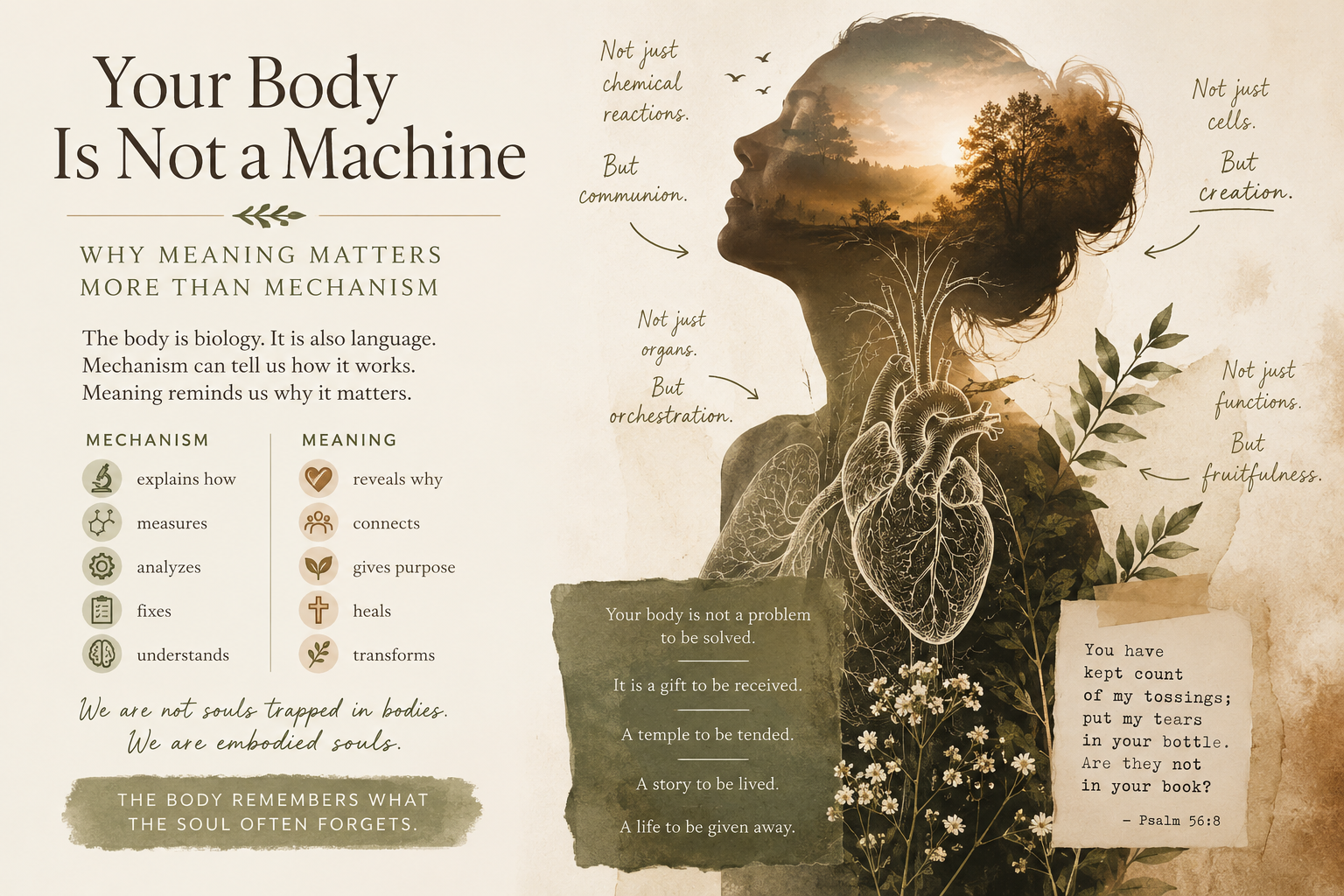
Why do we have tears?
Very few people will answer, "To lubricate the cornea, remove debris, and deliver antimicrobial proteins." They will say, "Because we cry when we are sad." and that answer is more true. We instinctively reach for meaning before mechanism. We think of grief before nervous system, of joy before physiology, of love before anatomy. And I wonder if that instinct is telling us something important about what it means to be human.
Modern health culture is fascinated with mechanisms. We measure hormones, microbiomes, glucose curves, inflammatory markers, neurotransmitters, heart rate variability, mitochondrial function, detoxification pathways, bile acids, and mineral status. And I do like to know about these things in my work at Viriditas Life. I spend hours reading research papers and looking at laboratory patterns because understanding how the body works matters.
But mechanism answers only one question: How? It tells us how muscles contract, how sleep repairs the brain, how insulin regulates glucose, and how the microbiome influences immunity. It rarely answers the question that every human being eventually asks.
Why?
Children understand this naturally. They don't ask, "How does the heart pump blood?" They ask, "Why do I have a heart?" And we don't begin to explain it with cardiac output or electrical conduction. We tell them that the heart is for loving, for being brave, for caring for others. Only later do they learn about atria and ventricles.
Meaning comes first because human beings are not simply information-processing machines. We understand ourselves through stories, relationships, symbols, and purpose. Perhaps this is why so many people know more about their biomarkers than their own lives. They know their fasting insulin but cannot remember the last dinner they shared without looking at a phone. They know their cortisol rhythm but have forgotten what genuine rest feels like. They know every supplement in their cabinet but cannot answer a simple question:
What is health actually for?
Living longer is not the same as living well. Perfect laboratory values are not the same as flourishing. This is where Christian tradition offers something desperately needed: The body is never presented as a machine that carries the soul around until heaven arrives. It is presented as gift created by God. A body so valued by its Creator, tht He sent His Only Son to become one of us. So that His Holy Spirit may dwell within us.
The body is not an inconvenience to overcome but the very place where we learn love, dependence, work, rest, sacrifice, joy, and communion. It is biology, but it is also language. The heart is not merely a pump. It becomes the place of love. Hands are not simply tools for manipulation, they bless, comfort, create, and heal. Shoulders carry responsibility, feet walk pilgrimages, knees bend in worship. The stomach "knows" anxiety before the mind catches up.
I sometimes hesitate when health conversations become nothing more than optimization strategies: better sleep, better hormones, better glucose, better mitochondria, better labs, better weigh loss, better thyroid. All good things but the question behind it is:
Better for what? To work more? To worry less? To live longer? To produce more? To make more money? Without a vision of what health serves, health itself becomes another form of anxiety.
The irony is that we already understand this intuitively. Nobody remembers their grandmother because her inflammatory markers were optimal so she functioned well into her old age. We remember that she baked bread every Sunday, welcomed strangers, prayed the rosary in the evening, and somehow made everyone feel at home. Scientifically she was water, electrolytes, proteins, etc. Humanly she was joy, compassion, relief, warmth, and love.
Tears
Tears cleanse the eye, yet nobody remembers them for that. Mechanism tells us what tears are made of. Meaning tells us why they matter. We remember tears because they reveal what words cannot. One of my favorite verses has always been Psalm 56:8 which was engraved on a candle stand that one of my friends gave me when I was young and after experiencing a profound loss:
"You have kept count of my tossings; put my tears in your bottle. Are they not in your book?"
What an extraordinary image. God does not promise that tears will never exist. He promises that none of them are meaningless. Every tear is seen, counted., and gathered. That verse has stayed with me for years because it reminds me that suffering can not be explained by chemistry happening inside neurons. It is something personal, relational, and worthy of being remembered.
As a functional practitioner, I spend much of my day looking for patterns and mechanisms such as low bile flow, mineral deficiencies, blood sugar instability, circadian disruption, leaky gut, inflammation. These patterns are real, and addressing them changes lives. But every lab report belongs to a person with a story.
Maybe we spend so much time trying to optimize our bodies because we have forgotten to listen to them. Maybe our exhaustion is not only magnesium deficiency but also a deficiency of silence. Maybe our inflammation is not only dietary but relational. Maybe our nervous systems long for what monasteries always knew: rhythm, prayer, work, rest, beauty, community, and enough time to become human again. The body remembers what the soul often forgets, and every now and then, it speaks in tears.
The woman with elevated cortisol is often carrying responsibilities that were never meant to be carried alone. The man with chronic fatigue may have spent years believing that his worth depends on productivity. The mother with digestive issues may have forgotten what it feels like to eat a meal while sitting down.
The body is always biological but it is never only that. St. Hildegard understood this centuries before functional medicine existed. Her vision of viriditas (vitality) was not simply the absence of disease. It was fruitfulness and participation in God's order. A human being flourishes not merely through optimal biomarkers but through gratitude, friendship, prayer, meaningful work, beauty, rest, generosity, and hope. Biology supports these realities. This is why I believe meaning matters in healing. Not because every illness hides a secret spiritual lesson or because symptoms are coded messages from the universe. Not because disease is punishment but because human beings cannot live on mechanisms alone.
We naturally search for purpose because we were created for communion with creation, with one another, and ultimately with God. When we lose meaning, even perfect physiology feels empty. When meaning returns, healing becomes more than symptom management. It becomes the slow restoration of order, relationship, rhythm, and life.
So perhaps the most important question is not, "How does the body work?" Science gives us wonderful answers to that question. Perhaps the deeper question is, "What is the body for?" Because mechanism explains how the heart pumps blood but meaning reminds us why we should give ours away. Mechanism explains how tears protect the eye yet meaning reveals why they have always been understood as love, grief, repentance, compassion, and joy made visible.
We were never created merely to function. We were created to matter.