What can the saints whom Hildegard celebrated in her writings and music teach us about courage, spiritual vitality, and holiness?
When we study St. Hildegard of Bingen, we usually begin with her visions, her understanding of creation, her music, or her writings about the human body and natural remedies. But there is another way to understand her spirituality: by looking at the saints she chose to celebrate. Three figures stand out in a particularly personal way: St. Ursula, St. Disibod, and St. Rupert.
Hildegard devoted an extraordinary collection of musical compositions to Ursula and her companions. She also wrote biographies of Disibod and Rupert, the saints associated with the two monasteries that shaped her life, the first which she entered and the second which she built. These were not simply historical figures whom she admired from a distance. Their stories became part of the spiritual formation of her communities. And although these three saints lived very different lives, their stories illuminate something central to Hildegard's theology: holiness is not an abstract ideal. It is the work of divine grace in real human beings, with their particular circumstances, responsibilities, struggles, and vocations.
St. Ursula: Courage, Consecration, and the Freedom of Women Who Belong to Christ
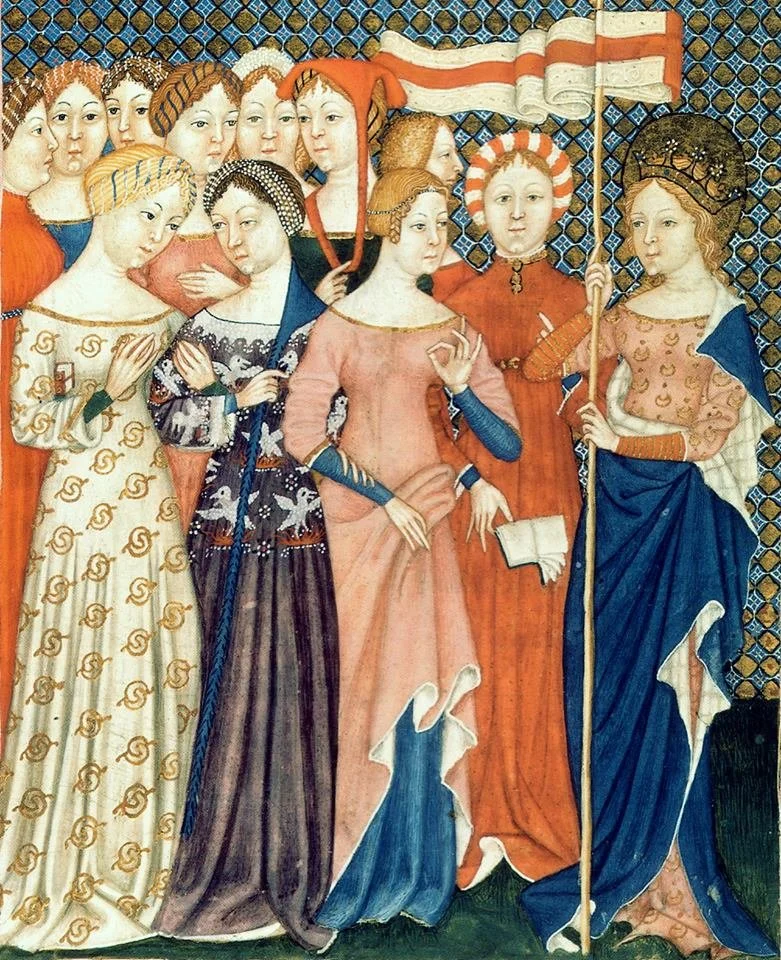
Of the three saints, Ursula receives the most extensive musical attention from Hildegard. According to medieval tradition, Ursula was a Christian princess from Britain who journeyed with a large company of consecrated virgins and was eventually martyred at Cologne. The historical basis of this story is uncertain. An early Christian tradition of virgin martyrs at Cologne eventually developed into a much more elaborate account, and many of its familiar details cannot be verified. But to understand Hildegard, we must also understand what this story meant to Christians in the twelfth century. Ursula was not simply a young woman who died defending her virginity. She was represented as a spiritual leader who guided a company of women toward their heavenly destiny.
In Hildegard's sequence O Ecclesia, Ursula is a woman who responds to a divine calling, but whose extraordinary vocation is not immediately understood by those around her. Ursula encounters resistance and disbelief. Yet she remains faithful to what she understands God is asking of her. Hildegard herself knew something about that experience. When she began establishing her independent female only monastery at Rupertsberg, she encountered opposition. Her decision to move the women away from Disibodenberg was controversial, not least because it affected the existing monastery's community and resources. Hildegard insisted that the foundation was part of her divine calling, even when others challenged her judgment. Both of them had a call to something that others initially resist. Both had to persevere. And both understand fidelity to God as more important than worldly approval.
Hildegard composed an unusually extensive cycle of chants honoring Ursula and her companions, including eight antiphons associated with Lauds (Morning Prayer), as well as responsories, a hymn, and a sequence. For Hildegard's nuns, the story of Ursula was not merely an account of heroic women from the distant past. It spoke directly to their own vocation. The medieval understanding of consecrated virginity drew heavily upon the biblical image of the Church as the Bride of Christ, especially the Song of Songs. Hildegard's compositions use rich imagery of flowers, precious stones, blood, light, and heavenly beauty. For Hildegard, that was the foundation of true spiritual strength: not self-assertion for its own sake, but a human will increasingly conformed to divine love. Her story invites us to ask whether we have confused peace with avoiding conflict, humility with silence, or obedience with an unwillingness to confront wrongdoing. Sometimes fidelity requires perseverance precisely when our vocation is misunderstood.
St. Disibod: The Exiled Bishop Who Became a Spiritual Gardener
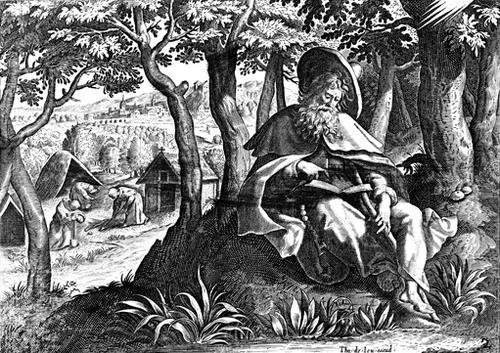
St. Disibod was associated with the monastery where Hildegard spent the first four decades of her religious life. Tradition identifies him as a seventh-century Irish bishop who eventually settled in the German lands at the site later called Disibodenberg. We know relatively little about the historical Disibod independently of the medieval traditions surrounding him. But Hildegard's biography, Vita sancti Disibodi, written around 1170, is remarkably revealing, not only about the saint, but also about Hildegard's understanding of spiritual leadership.
In her account, Disibod is born into a prosperous family in Ireland and enters religious life. He desires contemplation and the pursuit of divine wisdom but his community chooses him to become a bishop. He accepts the responsibility, teaches the faith, and works to reform those entrusted to him. His ministry eventually provokes serious opposition. According to Hildegard, he is driven from his episcopal see and leaves his homeland with companions as an exile. This part of Disibod's life is particularly important: he does not leave Ireland as a triumphant missionary who has completed a successful assignment. He leaves after conflict, rejection, and the loss of his position. From a worldly perspective, his ministry might appear to have ended in failure yet Hildegard does not interpret his departure as the end of his usefulness to God, it becomes the beginning of another form of spiritual fruitfulness.
Eventually Disibod reaches the region where he establishes a life of solitude, prayer, fasting, and contemplation. Other men gather around him and a monastic community develops. What looked like the collapse of one vocation becomes the foundation of another.
This is an important lesson for anyone who has experienced an unexpected change in life: loss of status, displacement, retirement, separation from a community, or the ending of a role that once defined them. Christian tradition does not teach that every painful event is directly willed by God. Injustice remains injustice but God is not limited by the circumstances in which we find ourselves. The loss of ecclesial position does not necessarily mean the loss of our vocation to bear fruit.
One of the most beautiful aspects of Hildegard's biography is her description of Disibod as a spiritual gardener. She compares him to a maker of pigments, spices, or medicinal preparations who cultivates aromatic plants and carefully preserves the greenness of his garden. The garden represents the interior life, and its greenness represents spiritual vitality. Disibod cultivates virtues as a gardener tends living plants. His life is not automatically fruitful because he holds the office of bishop. It becomes fruitful through the sustained cultivation of prayer, discipline, wisdom, and charity.
In her antiphon O viriditas digiti Dei, Hildegard also associates Disibod with the greenness of God's creative power. This helps us understand why viriditas cannot be reduced to health, vitality, or physical rejuvenation. In Hildegard's theological world, viriditas expresses life received from God and manifested in creation and the human soul. Disibod holds spiritual vitality not because he avoids hardship, but because he remains rooted in God through hardship. The garden survives the exile.
There is another fascinating detail in Hildegard's account. Disibod himself practices a demanding ascetic life, with fasting, vigils, solitude, and other bodily disciplines yet he does not require his followers to imitate the full severity of his personal practices. According to Hildegard, he permits his monks to follow a milder form of life under the Rule of St. Benedict. Why? Because he understands that not everyone has the same physical strength or capacity for rigorous asceticism.
This is especially meaningful coming from Hildegard, who herself emphasized discernment in the treatment and discipline of the human body. The strongest person in a community is not necessarily the one who demands the most from everyone else, but the one who knows how to help each person grow.
There is also a difficult historical dimension to Hildegard's decision to write his biography. By the time she composed it, she had already left Disibodenberg (male and female monastery) to establish Rupertsberg. Her relationship with the monks of her former monastery had not been without tension. When she wrote about Disibod's humility, holiness, and the degeneration of religious communities through pride or worldly concerns, she was doing more than recounting an ancient saint's life. She was also offering a reflection on what monastic life ought to be. Disibod became a model against which contemporary religious communities could examine themselves.
St. Rupert: Youthful Holiness, Charity, and the Heavenly Jerusalem
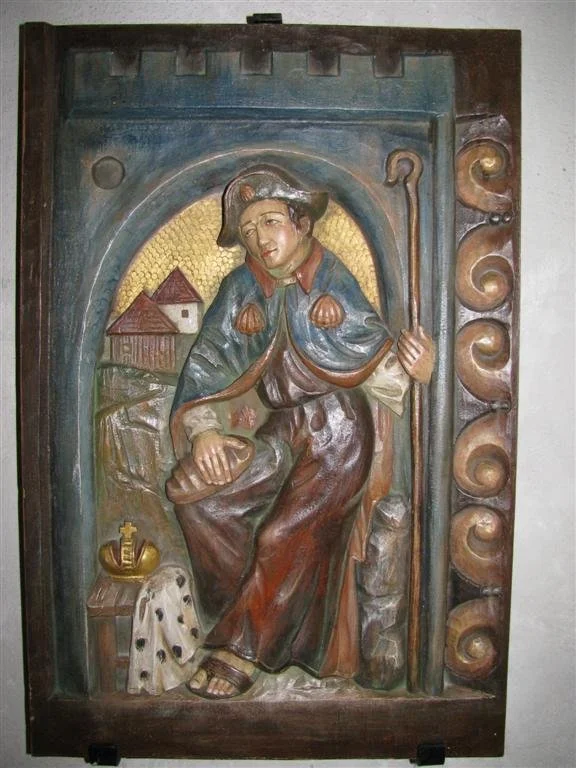
St. Rupert was the patron of Rupertsberg, the monastery Hildegard established near Bingen around 1150. According to the local medieval tradition preserved and developed in Hildegard's Vita sancti Ruperti, Rupert was a young nobleman associated with his mother, Bertha, and remembered for his devotion to God, purity, and charity. Unlike Disibod, who lived a long life of religious leadership, Rupert was celebrated for holiness attained in youth. Hildegard did not present sanctity as something that necessarily arrives after decades of religious practice. Rupert shows that a person can respond profoundly to grace even within a short life.
Rupert's story belongs to a familiar medieval category: the noble-born saint who refuses to make wealth, privilege, or social advancement the purpose of his life. His mother Bertha is also important in the tradition. Her religious influence and works of charity form part of the setting in which Rupert's holiness develops. Holiness is personal, but it is rarely formed in isolation. Families, teachers, monasteries, and communities all contribute to shaping a person's habits and understanding of what is worth pursuing. In Rupert's case, the mother-son relationship becomes part of the story of sanctity.
When Hildegard established her independent community, she located it at the site associated with Rupert. The choice had considerable practical and spiritual significance. Disibodenberg represented the beginning of her religious formation. Rupertsberg represented a new phase: the establishment of a community under her own leadership. The move was not easy. Hildegard encountered opposition and had to persevere through years of difficulty.
The new monastery eventually became the principal setting for her mature writings, musical activity, correspondence, and leadership. By dedicating the foundation to Rupert, she placed her community within the spiritual memory of the place. The saint's story gave the women a patron and a model of fidelity.
One of Hildegard's most magnificent compositions is O Ierusalem, a sequence written in honor of Rupert. It opens with an address to the golden city of Jerusalem, adorned with royal beauty and filled with light. The imagery draws upon the biblical heavenly Jerusalem, especially the Book of Revelation. Hildegard then celebrates Rupert's childhood and youth through images of dawn, sunlight, precious stones, flowers, and flourishing life. The contrast between light and darkness, vitality and corruption, is characteristic of her theological imagination. Rupert's holiness is represented as something beautiful, radiant, and fruitful. Modern culture often measures a life by its accomplishments: education, career, relationships, financial success, health, influence, or longevity but the Christian measure of a life is ultimately different. A person may accomplish relatively little by worldly standards and yet become profoundly holy.
Three Saints, Three Different Expressions of Viriditas
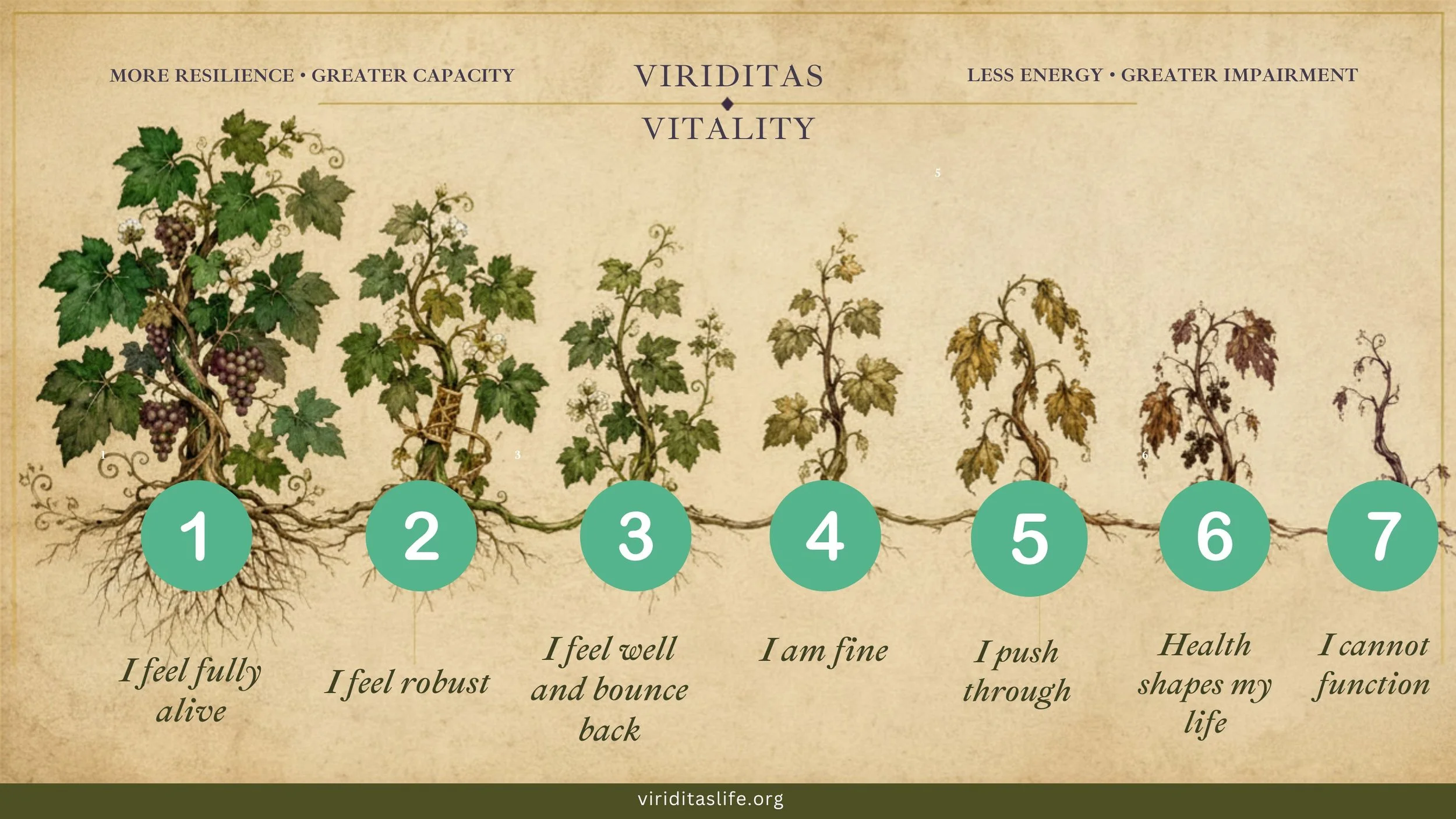
What makes these three saints particularly compelling is that their lives were so different. None of them represents the modern ideal of a perfectly ‘optimized life’:
Ursula represents courage and fidelity in the face of violence and death. Ursula is martyred.
Disibod represents perseverance, the cultivation of virtue, and fruitfulness after displacement and rejection. Disibod is exiled and experiences opposition.
Rupert represents the possibility of holiness in youth and the orientation of human life toward its eternal destiny. Rupert dies young.
We sometimes speak about Hildegard as though she taught that health, greenness, and vitality were the highest expressions of human flourishing. Physical health is good, the body matters, the rhythms of creation matter. Nourishment, rest, moderation, and responsible care of the body have their place. Yet these goods are not absolute.
Hildegard's saints remind us that a person can remain spiritually fruitful even when bodily strength diminishes, social circumstances collapse, or life itself comes to an end. The deepest source of vitality is not our ability to control our circumstances. It is God.
Ursula, Disibod, and Rupert did not become holy by following the same program. Their vocations, circumstances, responsibilities and forms of discipline differed. This is important because we sometimes approach spiritual formation as though one method should produce the same results in everyone.
But the cultivation of virtue always takes place within the reality of a particular person. The aim is not to manufacture identical lives but to cooperate with grace in the life we have actually been given.
There is a temptation in modern spirituality, including Christian wellness culture, to turn everything into a technique. We search for practices that promise better health, emotional regulation, more energy, stronger relationships, deeper prayer, and greater peace. Many practices can genuinely help us care for our bodies and support our spiritual lives. But techniques alone cannot produce holiness.
Ursula's courage cannot be reduced to a nervous-system regulation strategy.
Disibod's perseverance cannot be explained simply as resilience training.
Rupert's charity cannot be measured by a productivity scale.
These saints remind us that human beings are more than collections of biological functions, psychological responses, or habits. We are persons created in the image and likeness of God, called to relationship with Him and with one another.
As her nuns sang about Ursula, Disibod, and Rupert, they were not simply learning information about admirable people. They were participating in the Church's remembrance of holiness and being invited to cultivate the same virtues in their own lives. This is one of the reasons music was so important in Hildegard's spirituality. The truths of faith were not merely explained. They were sung, contemplated, remembered, and woven into the daily rhythm of prayer.
Listen to Hildegard's music and explore her writings
St. Ursula and her companions: O Ecclesia, Cum vox sanguinis, and O rubor sanguinis.
St. Disibod: O viriditas digiti Dei, O mirum admirandum, and Vita sancti Disibodi.
St. Rupert: O Ierusalem, O beatissime Ruperte, and Vita sancti Ruperti.