What Is Missing in Discipleship?
What I learned in my first year as an FDNP and Specialist in St. Hildegard Sciences
During my first year practicing as an FDNP and Specialist in St. Hildegard Sciences, I expected to become better at understanding labs, gut dysfunction, hormones, stress physiology, nutrition, fasting, supplements, sleep, metabolism, and nervous system regulation. But after taking three cohorts through HARMONY, I have come to see something much bigger. Many of the problems I encounter are not simply health problems. They reveal something that is often missing in modern Christian discipleship.
IN-Formation, Formation, TRANS-Formation
Get over not liking AI images, they are useful.
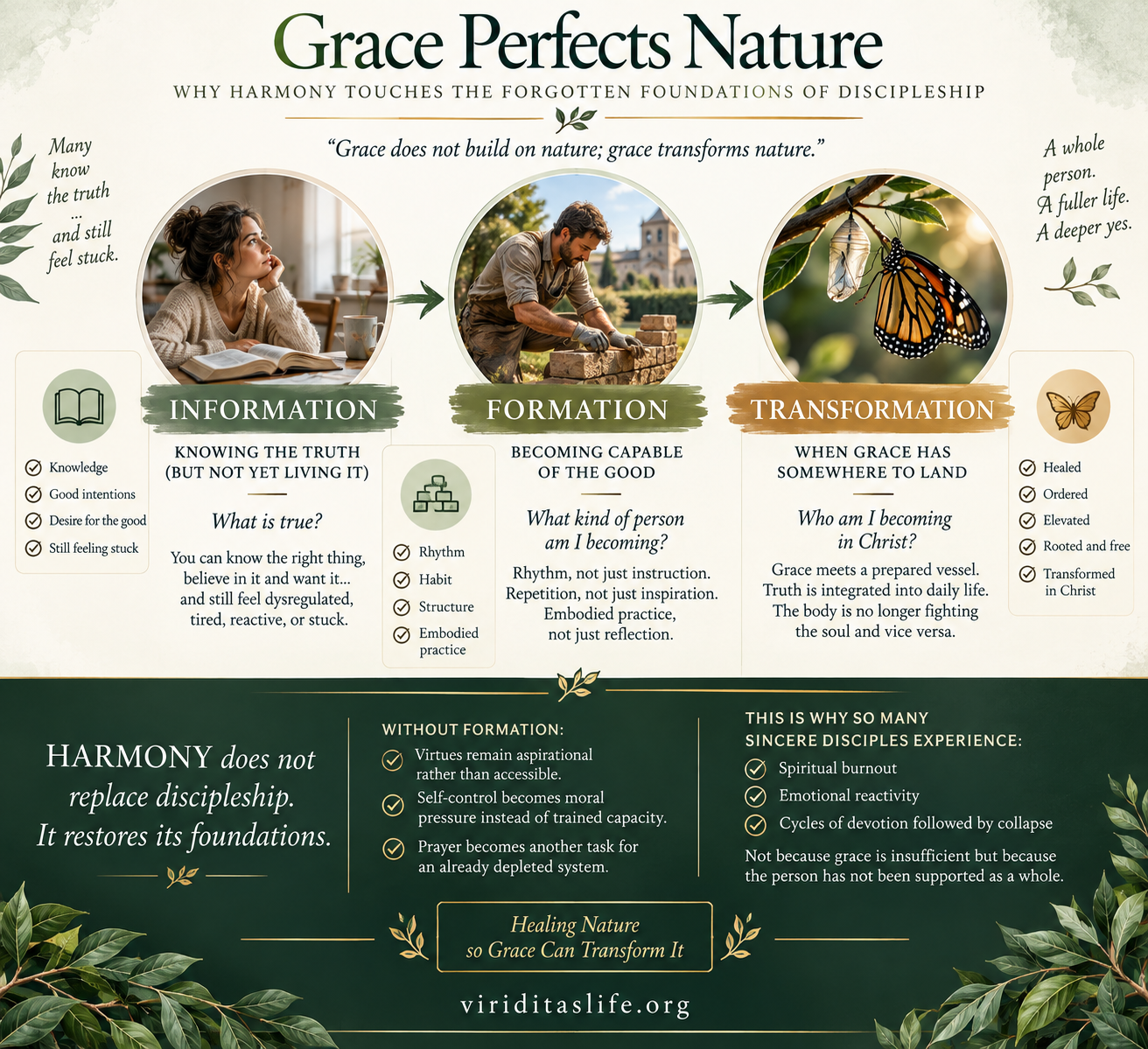
Week 9 in HARMONY zooms out to see the big picture.
We have become very good at giving people information and we expect that they will jump into transformation with a bit of formation. We tell them what is true, what they should believe, and how they should live. Yet a person can know the truth, believe it, genuinely desire the good, and still be exhausted, reactive, dysregulated, or unable to consistently live what she knows. Knowing the right thing is not the same as becoming capable of living it.
“Brothers, now that we have asked the Lord who will dwell in his tent, we have heard the instruction for dwelling in it, but only if we fulfill the obligations of those who live there. We must, then, prepare our hearts and bodies for the battle of holy obedience to his instructions. ”
Formation requires rhythm, repetition, and embodied practice, not only instruction and inspiration. It requires time so the body and mind can access the grace of living virtuously, it requires structure so the rhythm of life can form natural capacity for the good.
Transformation happens when the grace of God can land somewhere instead of being wasted. Yes, we are weak, disorganized, wounded, sickly, yet we need to cooperate with God’s grace by surrendering our nature to Him so He can start perfecting it. And that requires not only volition, not just wanting it, but embodied, actionable cooperation. Otherwise, we move in circles.
Healing Is Never Just Physical
People may initially come to VIRIDITAS LIFE because of fatigue, gut problems, poor sleep, weight gain, hormonal changes, inflammation, brain fog, or anxiety. But before long, another picture begins to emerge. There is grief, fear, resentment, years of overwork, poor boundaries. There is loneliness, relationships that drain vitality, emotional or mental exhaustion. There are people who have spent years serving everyone. Sacrifice is great, depletion to the level of dysfunction is mostly not.
This is why I no longer see whole person healing as an interesting addition to health care. It is essential. The human person is body, soul, and spirit. Christian discipleship cannot focus intensely on the soul while treating the body as though it were merely transportation for the spiritual life.
Sometimes we tell someone to pray harder when they desperately needs sleep. Sometimes we tell someone to exercise greater self control while ignoring the fact that they have been living in physiological survival mode for years. That does not eliminate responsibility. It helps us understand the person who is trying to respond.
Information Is Not Formation
Christians have enormous access to information. We have Bible studies, podcasts, conferences, books, homilies, retreats, and online courses. Many faithful people already know a remarkable amount. Yet knowledge alone does not necessarily produce transformation.
Without formation, virtues can remain aspirations rather than lived capacities. Prayer can become one more task for an already depleted person. Self control can feel like constant moral pressure rather than a capacity that has gradually been trained.
The question I am increasingly interested in is not simply, “Why are you not doing what you know?”
It is, “What is preventing you from living what you know with greater freedom and peace?”
That is a very different question.
The Body Belongs in Discipleship
Early Christian formation was remarkably embodied. It involved daily prayer, fasting, feasting, work, rest, posture changes, silence, community, seasons, and repetition. Formation was rhythmic, communal, bodily, and gradual. Modern discipleship can sometimes leap from conversion straight into mission: Serve more, volunteer more, evangelize more, pray more, give more, care more.
But what happens when the person doing all of this is sleeping five hours a night, eating chaotically, living on caffeine and donuts, unable to rest, chronically overstimulated, and carrying years of unresolved stress? Eventually something begins to collapse. That is not necessarily a spiritual failure. It may be an indication that we have forgotten how embodied discipleship actually is.
St. Benedict Understood That Order Comes Before Peace
“What is not possible to us by nature, let us ask the Lord to supply by the help of his grace. If we wish to reach eternal life, even as we avoid the torments of hell, then - while there is still time, while we are in this body and have time to accomplish all these things by the light of life - we must run and do now what will profit us forever.”
This year made me appreciate the Rule of St. Benedict more bc it is so practical and insightful. Benedict begins with very ordinary things. Fixed times of prayer, sleep, work, silence, moderation, stability. He does not begin by demanding heroic virtue from people whose lives are disordered. He creates the environment in which virtue can gradually become sustainable.
Ordo, Pax, Fruitfulness: Order creates environment for peace, and peace creates environment for fruitfulness. Modern Christian culture can reverse that sequence. We exhort peace without restoring order. We demand fruit without cultivating rhythm. We call people into mission while overlooking exhaustion.
One of the things missing in discipleship may therefore be remarkably unglamorous: A rule of life.
Healing nature so grace can transform it.
St. Hildegard gave us another language that modern wellness culture often lacks. Viriditas: Vitality. I have become much less interested in simply getting people to perfect numbers and much more interested in asking whether life is returning. Are you sleeping better? Can you think more clearly? Do you have energy to pray? Do you enjoy your family again? Are you able to make decisions without panic? Have you regained curiosity, creativity, or joy? Can you serve without constantly collapsing afterward?
In my HARMONY material, viriditas describes the vitality that helps a person remain rooted rather than reactive and increasingly capable of responding freely. That is much closer to my understanding of health now. Health should make us more available for life, love, and vocation.
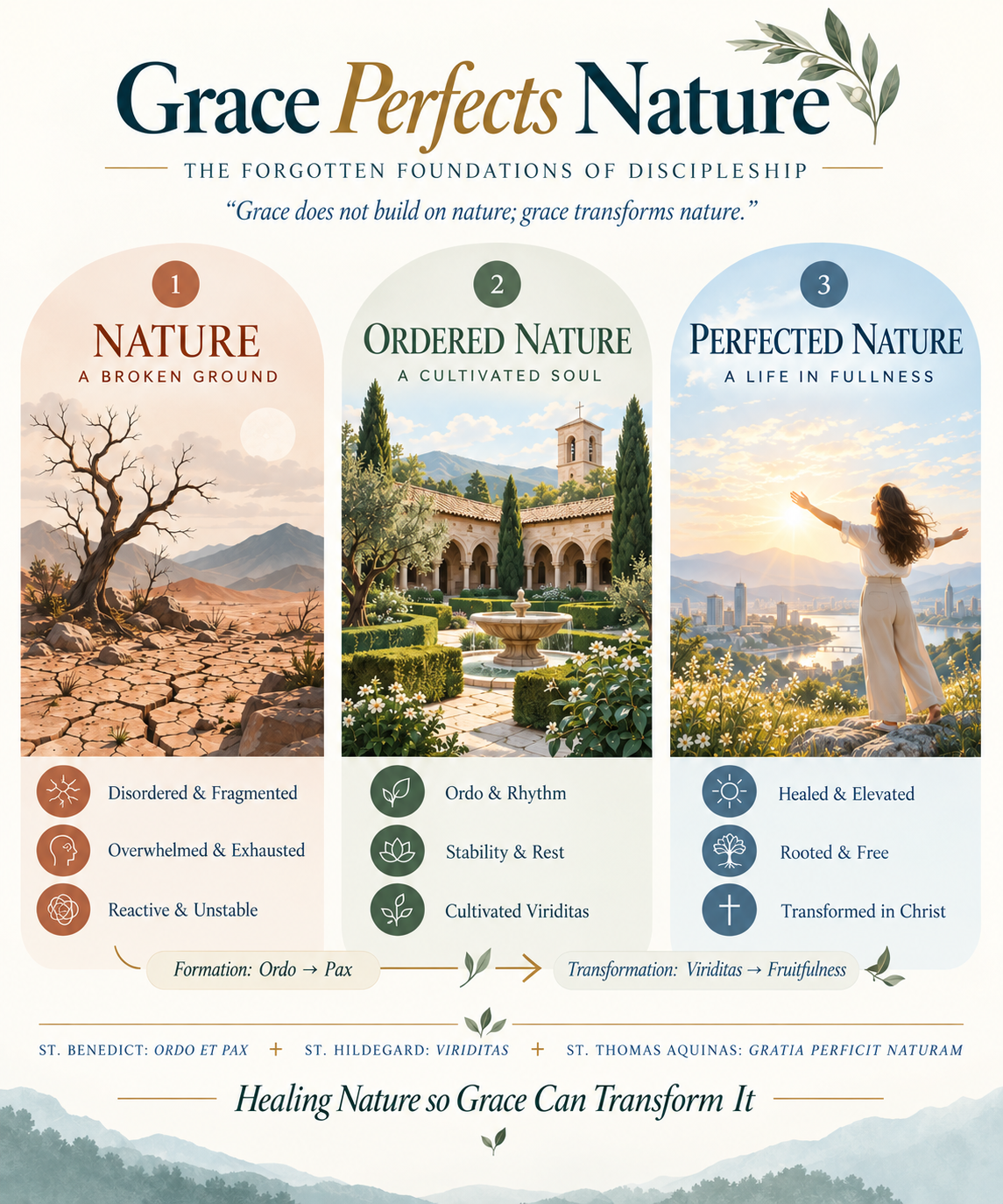
Week 9 in HARMONY reveals missing links.
The Nervous System Matters, but It Is Not the New Gospel
I have become far more attentive to the nervous system during this first year. Digestion, sleep, hormones, appetite, pain, emotional reactivity, and the ability to concentrate are all affected by chronic stress and nervous system overload. But I am equally cautious about turning nervous system regulation into another wellness religion.
The purpose is not to spend the rest of your life checking whether you are regulated but to become freer to pray, love, rest, tolerate discomfort, respond rather than react. Formation includes stabilizing sleep, nourishment, movement, and rest, reducing chronic overload, and creating repeatable practices rather than depending on emotional peaks. That belongs within discipleship because the Christian life is not simply about knowing the good. It is about gradually becoming capable of choosing it freely.
More Protocols Do Not Necessarily Mean More Healing
One of the most practical lessons I learned this year is that more is not always better. More supplements, restrictions, testing, things to track, at some point these can become another source of stress. I have seen people arrive after years of taking fifteen or twenty supplements from different practitioners. Sometimes the breakthrough is not adding the twenty first bottle. Sometimes it is simplifying.
This is where Hildegard’s emphasis on discernment has become increasingly important to me: What does this person actually need? What does she not need? What can she sustain? What is appropriate now? Not maximum intervention but an appropriate intervention.
Community Is Part of the Healing
I did not fully anticipate how strong the relationships within HARMONY would become. People make friends, pray for one another, encourage one another, celebrate progress together, see each other’s struggles, discover that they are not the only person dealing with fatigue, fear, health anxiety, or discouragement.
Christian formation has always been communal. We are not meant to become holy as isolated individuals consuming information alone. Perhaps this is also one reason that about half of them stay connected after finishing. They may initially come for health. But they discover rhythm, support, shared language, and community.
Real Transformation Is Usually Quiet
One ordinary week in HARMONY tells the story better than a dramatic testimonial ever could.
A seminarian joined because he wants to become healthier before giving himself more fully in service.
A woman ate eggs again after six years of avoiding them out of fear.
Someone began simplifying a supplement regimen that had grown to more than twenty products.
Another woman started seeing nervous system overload as part of the picture instead of assuming that every symptom must be caused by a pathogen.
Someone gave herself permission to heal over months rather than demanding transformation in three weeks.
Another woman scheduled several hours each week simply to do something that gives her joy.
Someone began processing painful experiences through writing and prayer.
A woman finally saw the scale move after months of being stuck.
None of this is flashy. There is no biohack of the week. There is no promise to fix your entire life in twenty one days. It is simply people gradually returning to order, truth, nourishment, rhythm, courage, discernment, and peace. That is increasingly what I mean when I use the word HARMONY.
HARMONY is not a Wellness Program
“Therefore we intend to establish a school for the Lord’s service.”
HARMONY has grown substantially during that time. The content is deeper. The structure is stronger. My own discernment as a practitioner has matured. I now understand more clearly what I am actually building. HARMONY is not simply a twelve week health or healing program. It is an attempt to recover some of the forgotten foundations of discipleship. Human limits are real and bodies matter. Rhythms and rest matter. Healing and mission must remain in relationship.
In Benedictine language, this is order before peace. In Hildegardian language, it is viriditas leading toward a fruitful and virtuous life. My HARMONY teaching describes this as nature being healed and ordered so that grace may perfect it. This is why I increasingly talk about HARMONY as a way of life. It is not simply about improving digestion or balancing hormones. It is about asking:
What kind of life supports the person God is calling you to become?
After my first year as an FDNP and Specialist in St. Hildegard Sciences, I am more convinced of the importance of functional health than when I began. But I am also less interested in health for its own sake. Perfect glucose is not the goal. Perfect hormones are not the goal. Perfect HRV is not the goal. An optimized nervous system is certainly not the goal. The goal of Christian life is transformation in Christ: A movement from fear toward trust, compulsion toward freedom, exhaustion toward stability, and fragmentation toward harmony. It is not only the soul that believes. It is also the body that carries that belief and the daily life in which it must be lived. Perhaps this is what we have sometimes missed. We have been discipling the intellect and motivating the will while assuming the rest of the person will somehow follow automatically.
But human beings need information, formation, and transformation. And the Catholic tradition reminds us that grace perfects nature (not ‘builds on nature’).
After three cohorts of HARMONY and a year of practicing what I spent so much time studying, I see these ideas converging more clearly than ever.
Discipleship is not merely teaching people what is true or jumping to transformation hoping it will happen. It is forming whole human beings who can increasingly live the truth they have received.
And perhaps that is one of the most important things we need to recover.
I have also learned that I do not do marketing well, I do not have stamina for 8h daily work, I spent half of time on business side of things, I can immerse myself in work when it is fascinating, I think this is my deepest work yet.