Before You Renew Your Mind, Present Your Body
Romans 12:1–2 and the strangely forgotten foundation of whole-person healing
Christians love Romans 12:2: “Be transformed by the renewal of your mind.” We quote it in sermons, counseling, discipleship, inner healing, and almost every Christian conversation about changing our lives. We talk about changing our thinking, replacing lies with truth, taking thoughts captive, and learning to see ourselves and our circumstances differently.
Before Romans 12:2 comes Romans 12:1: “I appeal to you therefore, brothers, by the mercies of God, to present your bodies as a living sacrifice, holy and acceptable to God, which is your spiritual worship.” Only then does Paul speak about not being conformed to the world, being transformed by the renewal of the mind, and learning to discern what is good. We often begin with the renewed mind, while Paul begins with the offered body. That is not a small detail. It changes the entire picture of Christian transformation and monastic ordes figured that out. When you join the order, you do not start with Aquinas, philosophy or apologetics. Postulancy is all about following the rhythm of the day, adjusting to the sleep, meals, prayer schedules. Adjusting to clothing, tools and work. Following ordinary days where the body regulates itself and adapts to the new way of life.
Romans 12:1 and 12:2 are not two unrelated spiritual instructions, one for the body and another for the mind. They describe one movement of transformation that begins with God’s mercy and involves the whole person. The body is offered, the mind is renewed, the person is transformed, and the fruit is discernment. This is much closer to a biblical understanding of whole-person healing than either “mind over matter” or its modern opposite, “the body knows best” or ‘follow your gut” or ‘trust your intuition”. Disregulated body does not know, the gut and intuition might signal giving in to vices/preferred and embodied weaknesses instead of aspiring to virtues.
Sometimes Christians speak as though the real spiritual life takes place somewhere above the neck. We emphasize beliefs, decisions, intentions, doctrines, and thoughts while treating sleep, food, hormones, movement, exhaustion, pain, breathing, and bodily rhythms as secondary matters that mature Christians should simply push through. Then someone becomes anxious, depleted, unable to sleep, unable to concentrate, chronically tense, and barely able to pray, and we give them another Bible verse to think harder about, to memorize and repeat.
Paul starts somewhere else. He tells us to present our bodies.
Christian worship is embodied because Christian life is embodied. We pray with bodies, fast with bodies, kneel with bodies, sing with lungs, serve with hands, carry children, bury our dead, become exhausted, grieve, celebrate with food, wake, sleep, experience pain, and receive comfort. The body is destined for resurrection. Bringing the body into healing is therefore not importing a trendy wellness idea into Christianity. Christianity had an embodied anthropology long before Instagram discovered the nervous system.
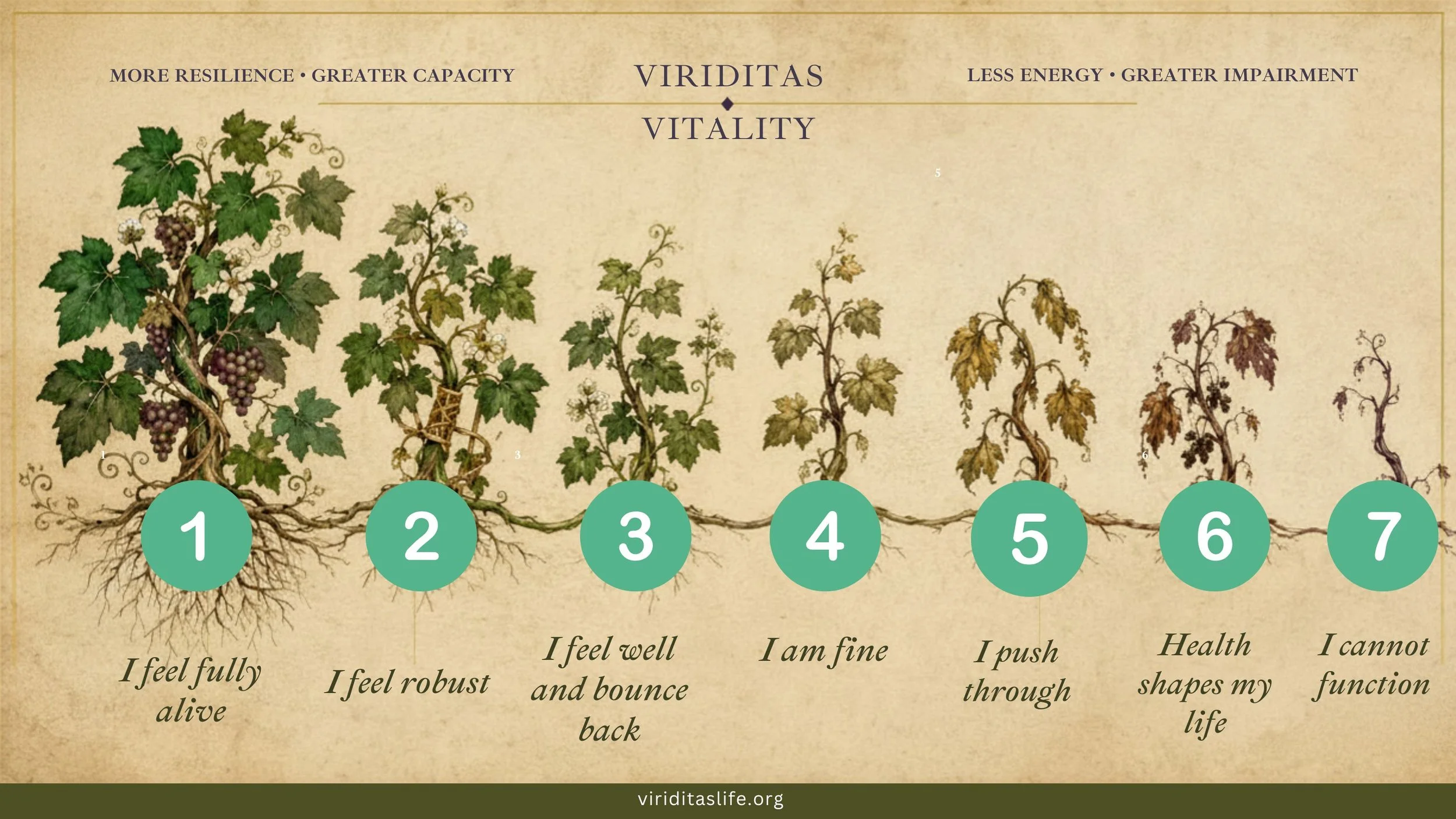
Join Fb Group to assess your vitality: https://www.facebook.com/groups/1054135514074277
Body keeps the score?
Modern trauma language has corrected an important error because what happens to us does not remain confined to abstract thought. A person can understand intellectually that a danger has passed and still wake at 3 a.m. with her heart pounding. Someone can forgive sincerely and still notice her shoulders tighten when a particular person enters the room. Grief can alter appetite, chronic vigilance can change sleep, and years of bracing can leave the neck and jaw chronically tense.
So when someone says, “I carry it in my shoulders,” she may be describing something very real. The problem comes when a useful metaphor becomes an entire anthropology and we begin to imagine the body as a filing cabinet in which traumatic stories are literally deposited into fascia, hips, jaws, or organs, waiting to be extracted.
What can remain are patterns. The body can continue doing what it learned to do by bracing, holding the breath, scanning, tightening, preparing, withdrawing, freezing, or staying awake. After years of repetition, those patterns can have real physiological consequences. A more accurate way to say it may be this: the body may not store the story, but it can continue rehearsing the response.
That matters because healing then becomes larger than “releasing” something from the body. The body may need a new experience, the mind may need truth, the person may need both, and Romans 12 gives us this integrated picture.
Paul does not say merely, “Listen to your body.” He says to present it. The Christian relationship with the body is therefore neither neglect nor worship. The body is not an enemy, but neither is it an oracle. It is offered.
This distinction matters enormously in modern wellness culture. We often hear phrases such as “My body is telling me no,” “My nervous system does not feel safe,” or “My body knows before my mind does.” Sometimes bodily signals contain important information and deserve careful attention, but a bodily sensation is not automatically a revelation.
A panic attack is intensely physical, but that does not mean a tragedy is occurring. A craving is bodily signal, but that does not mean the thing desired is good. A trauma response can be bodily, but that does not mean the present situation is identical to the past. Fatigue may mean rest is needed, but it may also reflect anemia, poor sleep, inadequate nourishment, hormonal changes, illness, overtraining, grief, or several of these together.
This is precisely why Romans 12 does not stop at the body. The body is offered, and then the mind is renewed so that we can discern. Sensation matters, but sensation requires discernment.
This is also why whole-person healing cannot simply mean “think better.” Renewal of the mind is crucial, but if we separate verse 2 from verse 1, it can easily become Christianized cognitive optimization in which we tell people to have the right thoughts, replace the wrong thoughts, and believe harder.
Give yourself a break
Imagine a woman who has spent years caring for everyone except herself. She sleeps five hours a night, eats whatever she can find standing at the kitchen counter, drinks coffee to compensate for exhaustion, carries chronic muscle tension, has stopped moving her body, and spends nearly every waking hour responding to someone else’s needs. She may indeed need renewal of the mind because perhaps she believes rest is selfish, love requires constant availability, or being needed is the same thing as being faithful. Those beliefs matter, but her body has also been living inside those beliefs. Her healing may therefore include recognizing the lie and going to bed, receiving God’s provision and eating adequately, renouncing hyper-responsibility and leaving the phone in another room, or learning that she is not required to save everyone and allowing her shoulders to come down from her ears. This is Romans 12 lived and bodies presented as sacrifices.
Elijah prophetic perception was distorted until his body got help.
The story of Elijah in 1 Kings 19 gives us one of Scripture’s most striking examples of this kind of whole-person care. Elijah has just come through one of the most dramatic victories of his ministry on Mount Carmel. Fire has fallen, the prophets of Baal have been defeated, and from the outside this should look like triumph. But the queen Jezebel threatens his life, and Elijah runs. He goes into the wilderness, sits down under a broom tree, and reaches the point where he says he has had enough. He is frightened, depleted, isolated, and emotionally spent. If we were reading that scene with only a “renew your mind” lens, we might be tempted to correct his theology immediately, remind him of what God had just done, or tell him to stop thinking negatively. God does not begin there.
Elijah sleeps. An angel touches him and gives him food and water. He sleeps again. He is awakened and fed again because, as the angel says, the journey is too much for him. Only after this bodily restoration does Elijah travel to Horeb, the mountain of God, where a deeper encounter takes place: a powerful wind, then an earthquake, then fire, but the Lord is not in any of them. After the fire comes the “still small voice,” or, more literally, the sound of a thin silence. It is there that Elijah encounters God in a new way.
Then comes the conversation. Elijah’s body has been fed and rested, but his perception is still not fully accurate. He believes he is essentially alone and that everyone else has abandoned the covenant. God corrects him and tells him that there are still seven thousand in Israel who have not bowed to Baal. Elijah then receives direction, a new assignment, and a way forward. Plus, he gets to mentor his disciple. The sequence is extraordinary because it is neither purely physical nor purely spiritual. Elijah does not need only food, but he does need food. He does not need only sleep, but he does need sleep. He does not need only a mystical experience, but he does need to encounter God. He does not need only reassurance, but his distorted prophetic perception does need correction. He also needs purpose, direction, and a companion.

Join Fb Group to assess your vitality: https://www.facebook.com/groups/1054135514074277
This is whole-person healing in biblical form. God tends to Elijah’s body, then speaks to his mind and heart, corrects his interpretation of reality, restores perspective, and sends him back into meaningful action. The body is not ignored, the mind is not ignored, and the spiritual dimension is not reduced to either one.
Sometimes before we interpret our entire spiritual condition, we need sleep. Sometimes before deciding that we have lost our vocation, we need nourishment. Sometimes before blaming ourselves for our lack of discipline, we need to ask what chronic stress, pain, hormones, blood sugar, isolation, or years of caregiving (think: you own kids) have been doing to the person who is trying so hard to be faithful.
At the same time, Elijah is not left permanently under the broom tree. Restoration does not end with comfort. His body is strengthened so that he can journey, encounter God, receive truth, regain perspective, and return to his calling.
Whole-person healing must be larger than nervous-system regulation or repeating verses in the morning.
This is also why Christian whole-person healing must be larger than nervous-system regulation. The goal cannot simply be to feel calm. If “regulated” means never activated, Jesus would hardly qualify. He grieved, confronted, experienced anguish, became tired, withdrew, acted decisively, wept, endured, and celebrated. Christian life contains fasting and feasting, lament and praise, silence and proclamation, exertion and rest. A healthy person is not someone who remains in a physiological tranquility but increasingly develops the capacity to respond adequatly.
Sometimes the right response is rest and sometimes it is action. Sometimes it is retreat and sometimes it is courage. Sometimes it is saying no and sometimes it is staying when every impulse says to run.
This is why HARMONY is interested in more than regulation. Regulation asks whether I can calm down. Resilience asks whether I can recover. Harmony asks a larger question: Can I become alive enough to respond well to what reality and God require of me?
The end of Romans 12:2 is often forgotten almost as much as verse 1. Paul does not say that the goal of renewed thinking is simply to feel peaceful. The renewed mind learns to discern. That raises better questions. What is actually happening here? What belongs to the past and what belongs to the present? Is this discomfort dangerous or merely difficult? Do I need rest, or am I avoiding something? Do I need to push through, or finally stop? Is this symptom related to stress, or does it require medical investigation? Is my fear protecting me or controlling me? Is this guilt calling me to repentance, or keeping me trapped in shame? This is discernment, and it belongs at the heart of whole-person health because neither the body nor the mind should rule alone. They must be brought into right relationship with reality, truth, and ultimately God.
Virtue belongs here too because virtue is never merely an idea. Courage eventually has to inhabit a body. The heart may pound and the voice may tremble, but the person speaks. Temperance also inhabits a body because desire is felt, but desire does not automatically dictate action. Patience inhabits a body that would prefer to hurry. Fasting places prayer into hunger, kneeling places humility into posture, singing places praise into respiration, and resting when God has given permission to rest can itself become an act of trust. Christian formation has always been profoundly embodied. We have simply sometimes forgotten the theology underneath the practices.
At HARMONY, whole-person healing does not mean throwing nutrition, nervous-system exercises, prayer, supplements, functional labs, and spiritual practices into one large wellness basket. It means recognizing that the human person is one. The body affects our experience of the world, the mind interprets what the body experiences, our habits train both, relationships shape both, virtue orders our responses, and spiritual life gives meaning and direction to the whole.
That is why Romans 12:1–2 may be one of the clearest biblical foundations for whole-person transformation: we offer the body, allow the mind to be renewed, become transformed, and learn to discern.
The modern catchy phrase says, “The body keeps the score.” Romans 12 gives us a more hopeful vision. The body may bear the consequences of what we have lived through, but it is not merely keeping a record of the past. The body can be offered anew, the mind can be renewed, old patterns can change, discernment can deepen, and the whole person can become more free, more ordered, and more alive.
That is viriditas/vitality: not permanent calm, not endless self-analysis, not domination of the body by the mind or domination of the mind by the body, but life returning to the whole person.
A Simple Place to Begin
If this way of thinking about healing is new to you, begin with Romans 12:1 before rushing to Romans 12:2. Ask not only, “What thought do I need to change?” but also, “What is happening in the body which I am presenting to God?” Notice what is actually there without immediately judging it or turning every sensation into a spiritual message. Are you exhausted? Undernourished? Chronically tense? In pain? Sleeping poorly? Holding your breath through the day? Living at a pace your body cannot sustain? Is there a symptom that deserves medical attention rather than another attempt to push through it?
Then bring the mind into the same prayer. Ask, “What am I believing about this? What is true? What belongs to an old pattern, and what is actually being asked of me now?” The goal is not to obey every sensation or overpower it with positive thinking. The goal is discernment. Present the body you have today, not the one you think you should have. Allow God to renew the mind that interprets its experience. Then ask for the grace to discern and do the next good thing.
This is also the reason I created HARMONY.
HARMONY is not a program that asks you to choose between functional health and spiritual formation, or between nervous-system work and renewal of the mind. It begins with the same assumption Romans 12 makes: the person standing before God is an embodied person, and transformation involves the whole of her.
In HARMONY we look at the physical patterns that may be draining vitality, including sleep, nourishment, metabolic health, digestion, hormones, stress physiology, movement, and daily rhythm. We also look at the patterns of thought, behavior, attachment, coping, and spiritual life that shape how the body is being lived. The purpose is not to turn every symptom into trauma or every laboratory marker into the answer. It is to develop the discernment to see what actually needs attention.
This is the deeper meaning of harmony: not making every part of life perfectly calm, but bringing body, soul, habits, rhythms, virtue, and spiritual life into a more ordered relationship so that the whole person has greater capacity to respond to God and to reality with freedom.
If you recognize yourself in this article, especially if you have been trying to “renew your mind” while your body remains exhausted, dysregulated, symptomatic, or depleted, HARMONY is where we put this whole-person approach into practice.
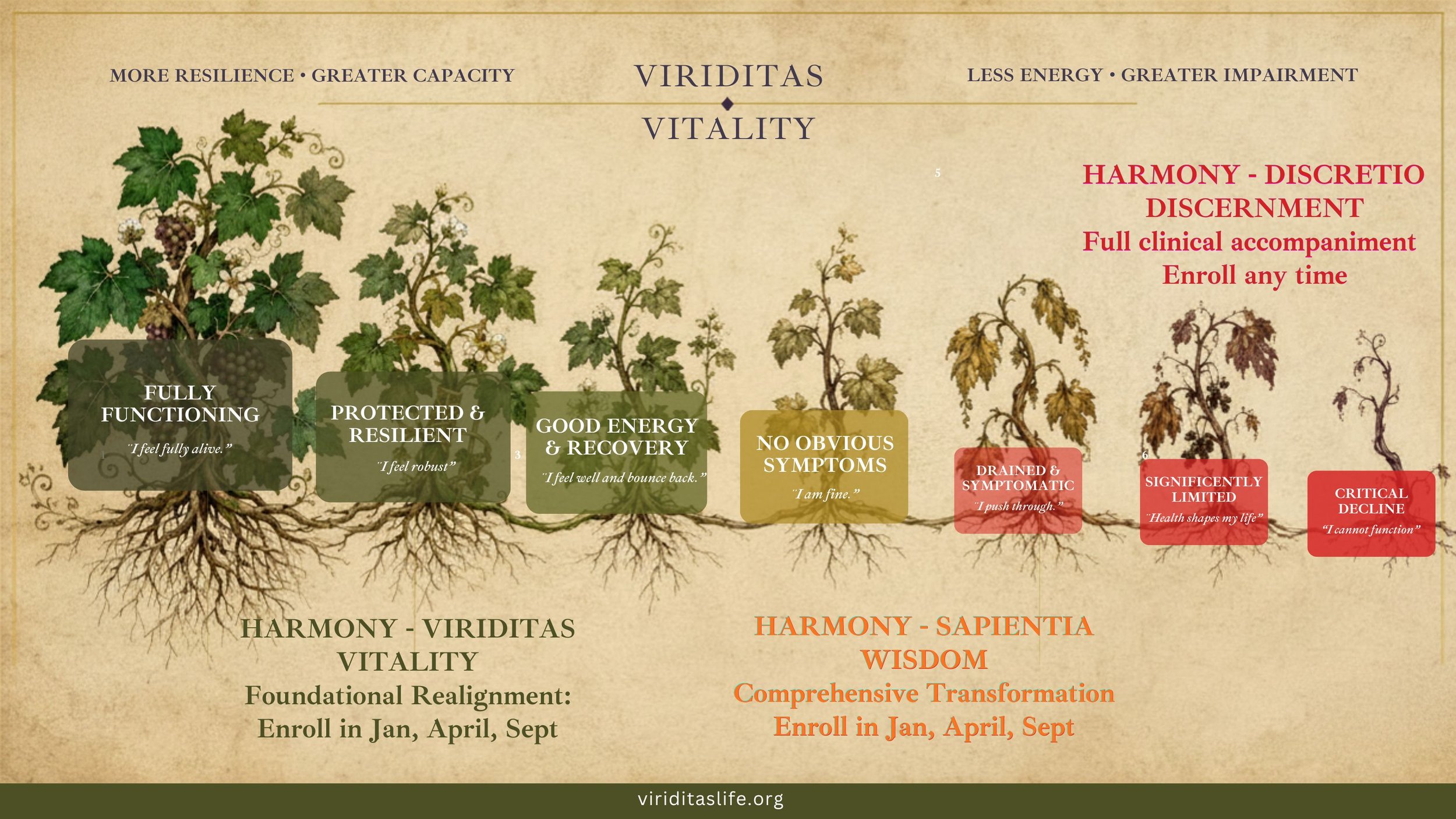
Three pathways to restore vitality.
Learn more about HARMONY at viriditaslife.org/harmony and book a call before Sept. 19 to save your spot in whole-person healing journey.