Deconstruction and the Religion of Desire
Deconstruction, Unbridled Passion and the Spirituality of the Abyss
And I will vindicate the holiness of my great name, which has been profaned among the nations, and which you have profaned among them; (…)
A new heart I will give you, and a new spirit I will put within you; and I will take out of your flesh the heart of stone and give you a heart of flesh. - Ezekiel 36:23-28 (RSVCE)
I was provoked for too long to write about this topic and recently prompted by listening to the story of Christa Black who as a Christian went on a psychedelic journey with her husband and returned to Jesus. I also had few conversations with real people, real former Christians who created their own world and altered their reality. The deconstructing boom is not over and will never be, it just took a quiet turn into seeking self within spiritualities that promise fulfillment but defile life. It’s rather an old tale and easily explainable yet with the addition of the therapeutic gospel it creates a pathway that the world tells you to respect yet we know how it ends.
What else does this craving, and this helplessness, proclaim but that there was once in man a true happiness, of which all that now remains is the empty print and trace? This he tries in vain to fill with everything around him…since this infinite abyss can be filled only with an infinite and immutable object; in other words by God himself. - Blaise Pascal
There is a kind of questioning that searches for truth. And then there is “deconstruction,” which is not a replacement for the traditional dark nights. Do not dare to do that to elevate the story of the few foolish ones with the stories of the mystics.
The questions of those who deconstruct in order to find their self will always end with permission. Permission to follow every desire, to call confusion “growth,” temptation “authenticity,” and rebellion “healing’. Eventually, as we know from few stories told and many untold, to abandon chastity, to break vows, to redefine marriage. The seeker here is not seeking the truth to which he will surrender. He is searching for a spiritual system that will surrender to him, flatter him and even tell him to believe his instincts bc it is always right. It is a search for an alibi to give into unbridles passions and to demand a right to live it.
The Spiritual Buffet of Our Times
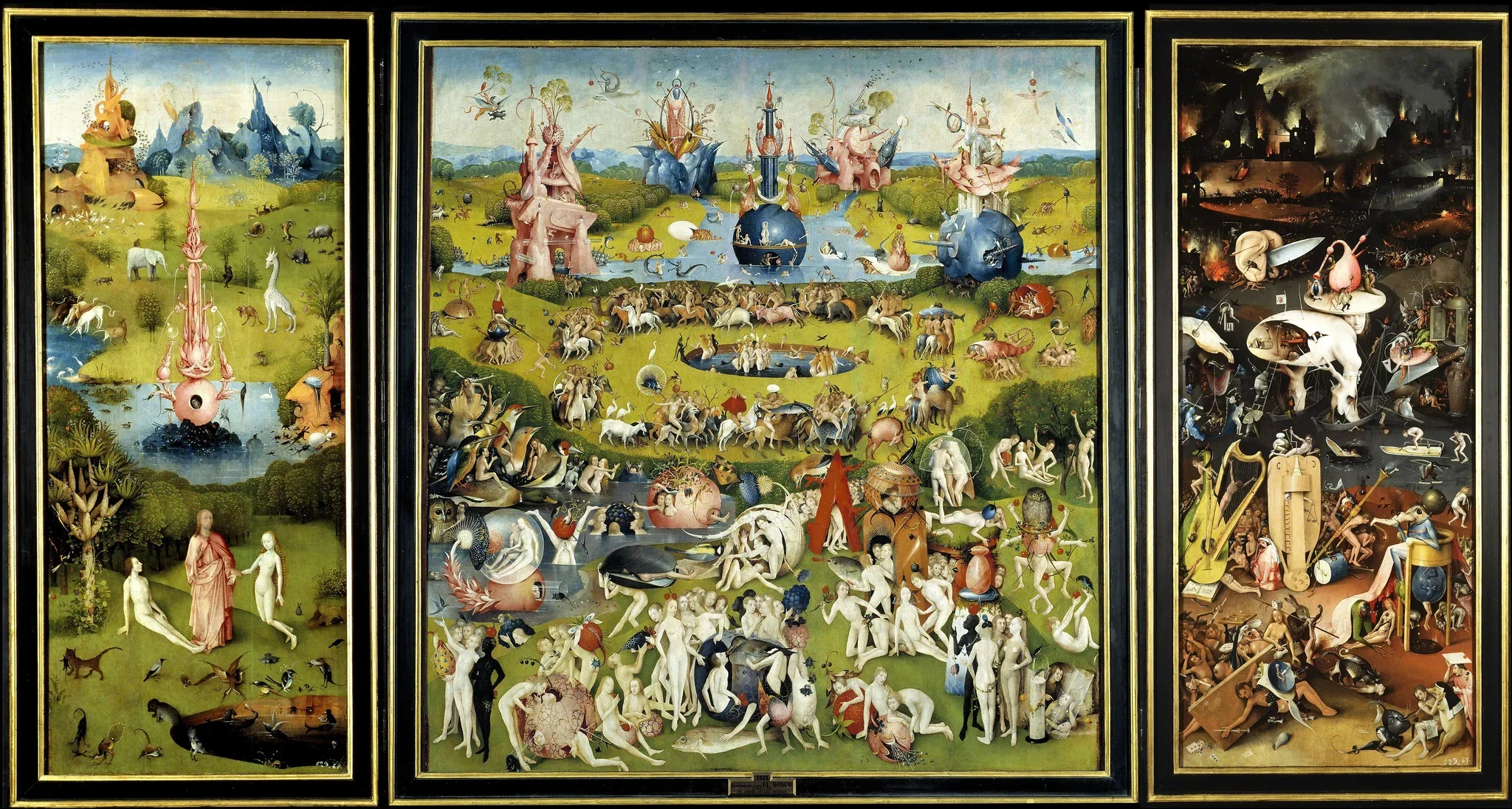
The Garden of Earthly Delights, Hieronimus Bosch (1490-1500) - Innocence and divine order give way to limitless experimentation, strange spiritualities, erotic novelty, bodily appetite and finally an abyss filled with creatures who have become outwardly what their desires made them inwardly
The modern seeker can assemble a religion as easily as assembling a lego kit. Psychedelics for revelation instead of prayer, shamanism for initiation instead of sacraments, manifestation for acquiring whatever one covets instead of faith, ethical nonmonogamy for avoiding fidelity, and erotic spirituality for giving lust a halo. Add a little Buddhism to stay relevant, a little Christianity without the Cross (Christ’s consciousness is a popular one), a little paganism without fear of God, and enough therapy language to silence anyone who asks an uncomfortable question.
“The theology of the devil is really not theology but magic. "Faith" in this theology is really not the acceptance of a God Who reveals Himself as mercy. It is a psychological, subjective "force" which applies a kind of violence to reality in order to change it according to one's own whims. Faith is a kind of supereffective whishing: a mastery that comes from a special, mysteriously dynamic will power that is generated by "profound convictions". By virtue of this wonderful energy one can exert a persuasive force even on God Himself and bend His will to one's own will.” - Thomas Merton
The result has no theology, no serious philosophy, no coherent anthropology, no moral authority but plenty of egoistic pleasure. It has a God of Experience encountered during expensive retreats where everything is “energy, alignment, the universe and integration.” Every known and unknown appetite is encouraged to show up. Every limit, including fundamentals of faith, becomes oppression and it needs to be overcome. Every criticism becomes judgment and it needs to be rejected. Every consequence is renamed as trauma and becomes the center piece of the healing trip which never ends.
How convenient.
This spirituality demands nothing except continuous attention to the self. It requires no creed, no repentance, no obedience, no sacrifice, no works of mercy and certainly no mortification of the flesh. Nothing here asks what is true, what is good, the only question that remains is: what serves me and how does it make me feel. All meaning has to come only from these two questions.
The Empty Throne Demands to Be Filled
Once sensation, novel tantric sexual experience, or ecstatic dance becomes the measure of freedom, the ordinary life with its past begins to feel unbearably mundane and dull. One ceremony is not enough. There must be another retreat, another plant medicine, another sexual experience, another relationship, another identity, another teacher, another initiation, another altered state, another spiritual breakthrough.
When the soul loses its center in the Triune God, emptiness does not disappear. It becomes ravenous. Whatever feels empty must be filled immediately. Silence must be filled with noise and loneliness must be filled with bodies. Anxiety must be filled with substances and boredom must be filled with stimulation. Shame must be filled with affirmation and spiritual hunger must be filled with ceremonies, visions and altered states. And the cognitive dissonance has to be resolved so the suppressed conscience can be replaced with the idea closely aligned with a lifestyle. No one in it calls it deception because delusion then sits on the throne of the rational brain. The appetite expands while the person shrinks.

This is the terrible law of disordered desire. It promises fulfillment but trains the soul to disavow the truth and to jump into the pool of ungoverned urges. The experience that once thrilled soon becomes normal and the boundary must be crossed again. Eventually, transgression itself becomes the drug. The addiction is called seeking. It is really an excuse to do what was deeply hidden in the dark parts of the heart before.
Scripture describes this movement with frightening precision. Saint Peter speaks of people whose “eyes are full of adultery and insatiable for sin” (2 Peter 2:14). Insatiable is the crucial word. Sin never satisfies the desire. The person thinks he is consuming experiences but the experiences are consuming him.
When Healing Becomes a Permanent Exemption
Of course, healing is real, trauma is real. The body remembers suffering and the nervous system can become dysregulated. People wounded by families, churches or religious leaders may need careful, compassionate help. Christians should never minimize suffering or use theology to protect abusers.
But healing can become an identity, an industry and an endless exemption from moral responsibility.
Some people are always “doing the work,” yet never become more truthful, faithful, patient or capable of love. They are forever processing but never forgiving. Forever protecting their peace but never carrying another person’s burden. Forever healing their ‘inner child’ while their actual children wait for them to grow up. Their entire life becomes a spiritual emergency centered upon the self.
Christ does not heal us so that we can spend the rest of our lives examining our wounds. He heals us so that we can rise, take up our mat and walk. Christian healing restores us to communion, responsibility, worship, work, fidelity and love. Its fruit is not endless fascination with oneself. Its fruit is the capacity for self-gift.
When Feelings Become the Supreme Authority
Christianity does not teach that feelings are evil. Passions (emotions, feelings) belong to human life. They can move us toward good or evil. Their moral quality depends upon whether they are governed by reason and ordered toward the good. Modern spirituality without clearly defined God and without faith principles aligned with Christain revelation removes that final sentence.
“I feel peaceful about it” becomes sufficient justification for adultery. “I feel alive for the first time” becomes sufficient justification for abandoning a family. “This feels authentic” becomes sufficient justification for breaking vows.
From Person to Appetite
Saint Jude describes people who “pervert the grace of our God into licentiousness” (Jude 4). That’s exactly what’s happening when grace becomes permission, mercy becomes the elimination of judgment, freedom becomes the absence of restraint, love becomes approval of every desire. Jude says that such people “defile the flesh, scorn lordship, and revile glorious beings” (Jude 8). They rely upon dreams and private experiences while rejecting the authority that might judge those experiences. Later he describes them as following their own desires, creating divisions and living “on the natural plane, devoid of the Spirit” (Jude 18 - 19).
This is crucial. A person may speak constantly about spirituality while living entirely on the natural plane of sensation, appetite and instinct. Spiritual language does not prove spiritual life, visions do not prove holiness. An altered state of mind due to psychedelics and frivolous New Age ideas is not the same as a state of grace.
Saint Peter is blunt when he compares those governed by corruption to “irrational animals” living by instinct (2 Peter 2:12). He says that they consider daytime pleasure a delight and “promise them freedom, though they themselves are slaves of corruption” (2 Peter 2:13 - 19).
This does not mean that any person loses his God given dignity but that a person created for reason, holiness, communion and eternal life can choose to live at the level of appetite, as a beast: eating, mating, escaping, avoiding, dominating, all with primal emotions showing up at every corner of every container. The tragedy is that this diminished and low existence is marketed as expansion.
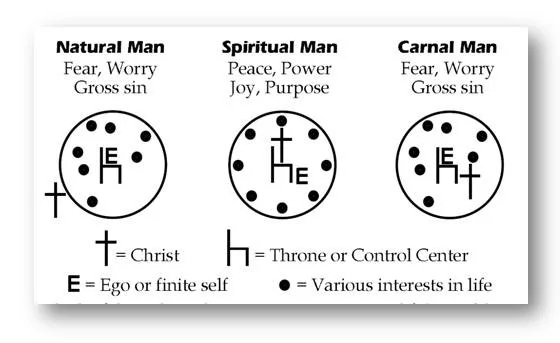
I learned this in the 80’s at Catholic Light Life Movement in Poland.
Paul calls this the natural person the natural person does not accept what pertains to the Spirit of God” because it appears foolish to him (1 Cor 2:14).This does not refer only to sexual behavior. It means the person governed by natural perception, emotion and appetite without the discernment of the Holy Spirit. Such a person may speak constantly about energy, consciousness and sacred sexuality while remaining, as Jude says, “on the natural plane, devoid of the Spirit.”
Paul also speaks of the carnal or fleshly person. (1 Cor 3:1-3). The flesh is the human person living apart from the order of grace. It is reason kissed goodbye, darkened by sin. Paul lists the works of the flesh as immorality, impurity, licentiousness, idolatry, sorcery, hatred, rivalry, jealousy, fury, selfishness, dissension, envy, drunkenness and similar things (Gal 5:19 - 21). This list resembles much of what is now marketed as liberation in the camps of these spiritualities without any anchors. This is especially serious for former Christians who once knew the call to holiness but begin living immorally while constructing a new spirituality to protect their life from judgment. They may insist that they have evolved beyond Christianity, but Paul might say they have become carnal, rejecting self-sacrifice, rejecting picking up the cross, rejecting struggle. They are no longer asking the body to participate in redemption. They are asking spirituality to excuse whatever their carnality demands.
The Things Once Feared Are Now Welcomed
To escape religious authority, they surrender their minds to shamans, psychedelic guides, erotic healers and influencers. To escape purity culture, they enter arrangements in which people are shared, compared, consumed and replaced. Everything they once feared in Christianity is suddenly welcomed without discernment because it suits the desires Christianity asked them to discipline.
A Jesus Who Never Contradicts You
Many people leaving Christianity do not entirely abandon Jesus. They resize Him. Jesus becomes a teacher of inclusion, a guide to higher consciousness, a symbol of radical authenticity, or one enlightened master among many. He blesses the journey, affirms the desires and never mentions repentance, never judges, never commands. He becomes soft version of the Gospel and a mental support loosely showing up among other deities of wellness.
We Always Become Someone’s Image
There are two opposite movements. Peter says that through Christ we may “become sharers in the divine nature” (2 Peter 1:4). He immediately contrasts this participation in God’s life with “the corruption in the world because of evil desire.”
One moves toward participation in the divine nature, the other moves toward corruption through disordered desire, dissolved into some universal consciousness. We are always being formed into someone’s image. If we are not being formed into the image of Christ, what image is being formed in us? If we reject participation in the divine nature, what nature begins to dominate our life? If Christ no longer teaches the body what it is for, who does?
We become like what we contemplate, imitate, obey and worship.
Returning to What One Had Escaped
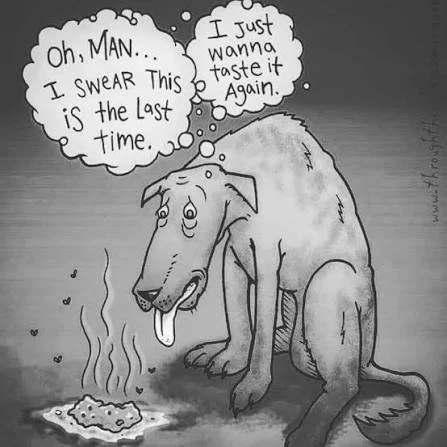
Peter gives a particularly sobering warning about people who have known Christ and then return to corruption: “For if they, having escaped the defilements of the world through the knowledge of our Lord and savior Jesus Christ, again become entangled and overcome by them, their last condition is worse than their first” (2 Peter 2:20). He concludes with brutal biblical images: the dog returning to its vomit and the washed sow returning to the mud. He is trying to wake people up. Someone who was being renewed in Christ begins to rebuild the old self. What was once recognized as bondage is now called freedom.
The Road Home
But this descent does not have to be the final chapter. No one is beyond the reach of Christ. Not the former leader, worship leader, wounded Christian. Not the person entangled in sexual chaos. Not the one who sought revelation through psychedelics, shamans, tarot cards or spirit guides. Not the person who has crossed so many boundaries that he no longer remembers where the first one stood.
Deconstruct faith with God instead of with your 'self' only.
Why is that important? When you deconstruct with God, you are not taking Him from your equation, nether you take yourself from His Presence.
When you deconstruct with God you are walking in humility instead of making your 'self' god.
When you deconstruct with God you are giving Him a chance to show himself other than, different, and unexpected than how you encountered Him thus far, and He is pleased for you not giving up on Him but only on your own imagination and experience.
When you deconstruct with God, your assumptions will fade away and your fears will subside proportionally to the desire you develop.
When you deconstruct with God you can not just go on your own, in your own headspace. You will need others because neither God neither His people live solo.
When you deconstruct with God, you will not feel loose, but you might have a chance to enter into more freedom. You were made to become free indeed. (…)
The abyss may be deep, but the mercy of God is deeper.
Christ does not wait at the edge merely to say, “I warned you.” He descends into the places where we have lost ourselves. He enters the confusion, exposes the false promises and calls the person back by name. The Father still watches for the prodigal who must “come to his senses” and arise (Luke 15:17- 20). He cannot remain among the swine, rename the mud “authentic living,” and call it reconciliation. Coming home may require more than a burst of religious emotion. It has to mean ending relationships and practices that cannot be reconciled with Christ. It has to mean renouncing occult involvement, leaving psychedelic spirituality, confessing sexual sin, telling the truth to people who were harmed, accepting consequences and rebuilding a life in long repentance.
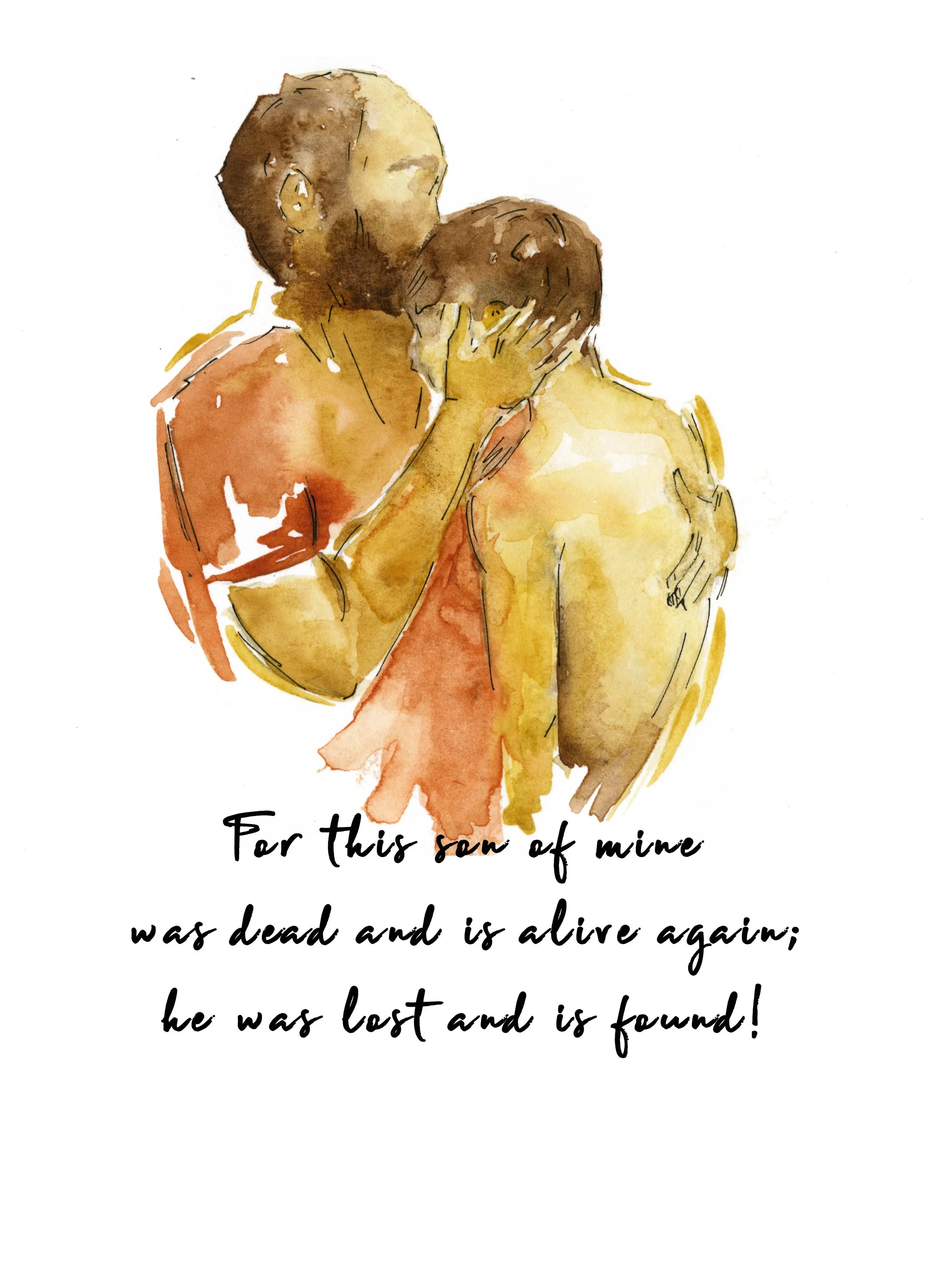
Prodigal by Teah Munoz
What Repentance Used to Cost: St. Basil on Serious Sin and the Long Road Home
Ancient Christianity did not reduce repentance to a quick apology. St. Basil’s fourth century canonical letters sometimes prescribed years of public penance for adultery, occult practices, abandonment of a lawful spouse and other grave sins. For example, for consulting soothsayers, following pagan customs, bringing practitioners for remedies/purification (Canon 83) which would equal today’s use of psychedelics in shamanic ceremonies for spiritual healing, cleansing, divination, “plant wisdom,” etc. the penance would be one year of ‘weeping’ outside the church doors, publicly acknowledging the sin and asking Christians entering to pray for you, then one year of ‘hearing’ the Scriptures inside the church during Eucharist but being dismissed before receiving Eucharist, three years of ‘kneeling’ with being allowed to lay prostrate in the sanctuary, and one year ‘standing’ with the faithful but not receiving Communion. Imagine this now days.
May God have true mercy on those who play with His sovereignty and delay their return. May their hearts of stone become hearts of flesh.