Discern the Suffering, Discern Your Cross
Everyone Has a Problem With the Cross
Today, September 14, the Church celebrates the Exaltation of the Holy Cross. We do not exalt abuse, trauma, illness, neglect, exhaustion, or suffering for suffering’s sake. We exalt the Cross of Christ because the instrument of death became the place where death itself was defeated.
Everyone has a problem with the Cross. Some Christians have called abuse a cross and told people to endure what should have been exposed, resisted, and stopped. The world has a different solution. It wants to call almost every cross abuse. If something costs too much, hurts too deeply, demands sacrifice, frustrates desire, exposes weakness, or disturbs our carefully regulated inner world, we are increasingly tempted to assume that something has gone wrong.
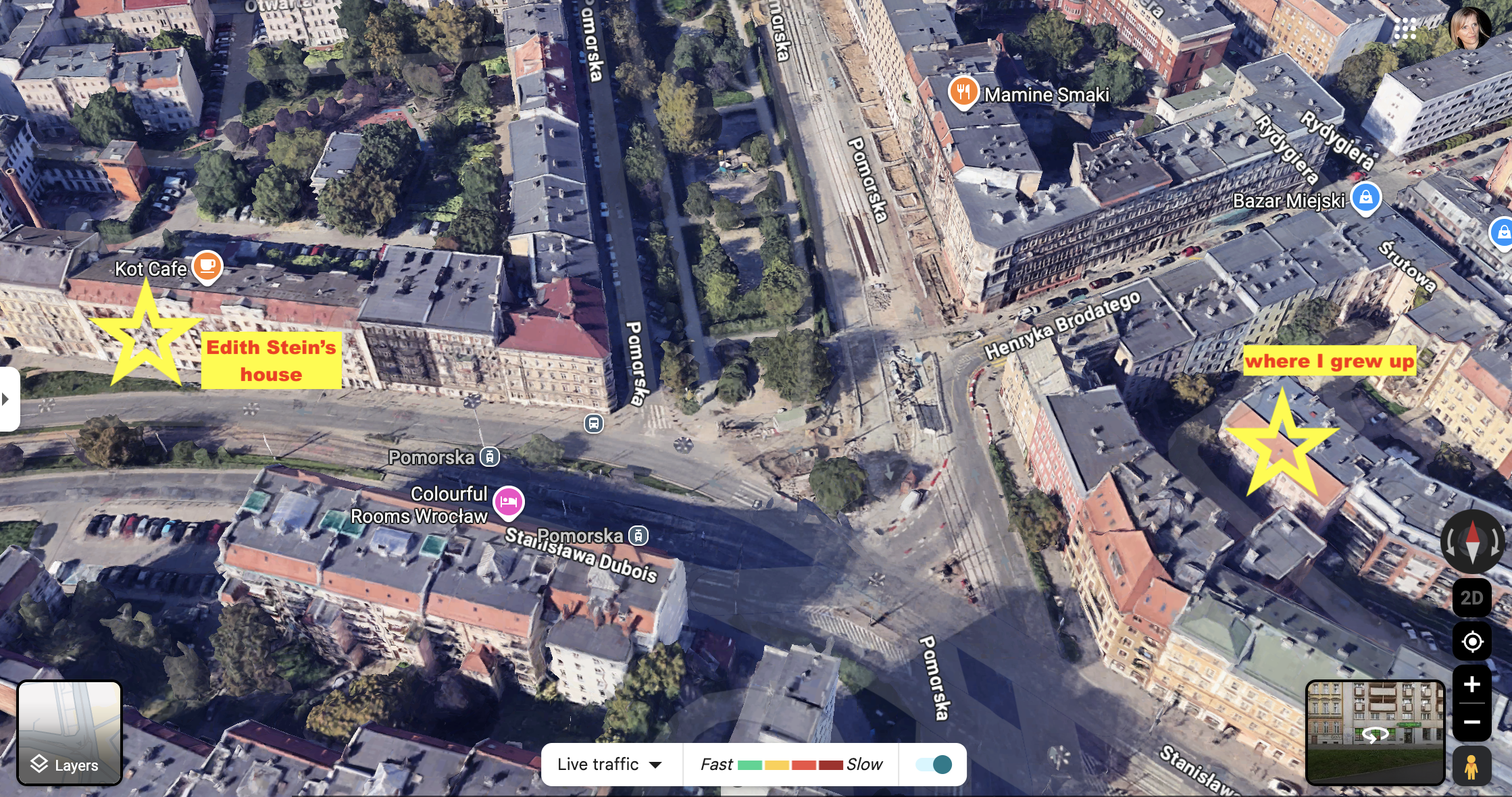
I grew up three decades after Edith’s martyrdom 5 min from where she spent her eary childhood (the building here is new) and I passed that place daily walking to my school. Then her family moved one mile away. My daughter, Teah, got her masters degree from the same University of Wroclaw, where Edith studied.
Edith Stein had no patience for a Christianity observed safely from a distance. Her final great work was The Science of the Cross, and she wrote: “If the mystery of the cross becomes the inner form of this science, a living energy that allows the soul to be molded by what is received from this mystery, it turns into a science of the cross.” The Cross is not merely an event we admire on Good Friday. It is meant to become an inner form, shaping how a Christian loves, chooses, suffers, forgives, sacrifices, and surrenders.
Stein understood that this knowledge is expensive. “I am satisfied with everything. A scientia crucis [science of the cross] can be gained only when one comes to feel the Cross radically. I have been convinced of that from the first moment and have said, from my heart: Ave, Crux, spes unica! [Hail, Cross, our only hope!].” This is not sentimental piety. The Science of the Cross cannot be learned while arranging our lives so carefully that nothing is ever permitted to wound our pride, inconvenience our plans, expose our weakness, or require us to die to ourselves.
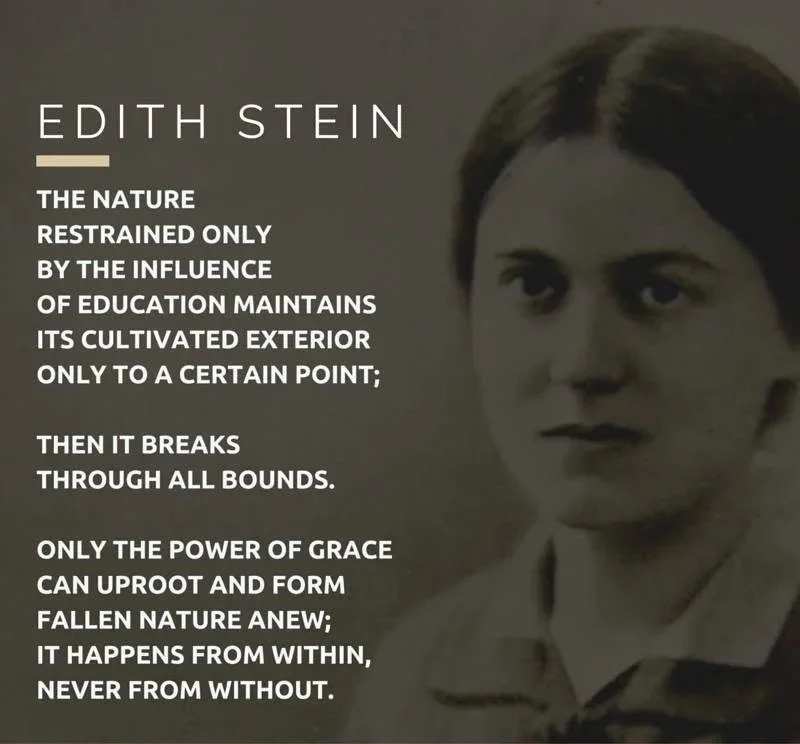
This is particularly uncomfortable in an age obsessed with self-monitoring. Stein warned that “excessive interior preoccupation with one’s own personal concerns can develop in the course of life into a general indifference to things religious.” We now possess endless tools for studying ourselves. We analyze our triggers, boundaries, wounds, attachment patterns, nervous systems, hormones, cortisol, glucose, sleep, HRV, supplements, emotions, and symptoms. Much of this is valuable. I work with many of these things myself. But there is a point at which healing becomes another form of self-absorption.
Functional health cannot become functional avoidance.
Nervous system regulation cannot become a sophisticated theology of never being uncomfortable. The goal is not to become so regulated that obedience never feels costly, forgiveness never hurts, fasting never makes us hungry, repentance never humbles us, service never tires us, and love never demands anything we would not naturally choose.

Illumination from Hildegard’s Scivias, Know the Ways
Sometimes your nervous system is warning you that you are in danger. And sometimes it is simply discovering that you are not in control or you are in a new, unpredictable situation. Those are not the same thing.
Hildegard gives us the word we desperately need: discretio = discernment. Not every suffering is a cross, but not every suffering is pathology. Not every difficult person is toxic. Not every unpleasant emotion is trauma. Not every stress response is a divine command to stop. Not every endurance is holy, but neither is every escape wisdom.
We have become very skilled at asking, “How does this make me feel?” Christianity asks another question: “What does love require?” Hildegard’s viriditas (vitality) is often romanticized into something soft and green and pleasant and tree hugging. But living things are not formed mostly by comfort but by resilience. They are nourished, pruned, trained, exposed to seasons, rooted more deeply, and strengthened by resistance. Christian vitality in Hildegard’s thought is not fragility protected from every storm but life so deeply rooted in God that it can remain fruitful even when the weather changes.
This is why functional health matters to me. I help to restore sleep, metabolism, digestion, hormones, mitochondria, minerals, rhythm, detoxification pathways, movement, and nervous system capacity because depleted people need care. But I also help to rewire brain and renew mind, to go back to prayer, and fasting, to restore relationships focusing on the main one, with God. The goal cannot simply be to feel better forever. Eventually the Christian must ask, What is this restored strength for? It is for love and vocation. It is for prayer and service. It is for repentance and courage and forgiveness. It is for standing when you would rather run and leaving when remaining would cooperate with evil. It is for knowing the difference, for discernment.
The world insists: remove the Cross. Bad spirituality says: Endure every suffering. Wellness culture: Optimize yourselves (until sacrifice itself begins to look unhealthy). Some charismatic Christianity is tempted to move so quickly to resurrection, victory, healing, and Pentecost that it forgets that the Holy Spirit does not bypass Calvary. Holy Spirit, Spirit of Christ, was present in Jesus’ body on the cross. The Holy Spirit did not come to make Christians Cross-free. He came to make us capable of becoming like Christ. Today the Church does not hide the Cross in embarrassment. She raises it high enough that we cannot pretend Christianity is merely about becoming peaceful, successful, healed, emotionally comfortable, and physiologically optimized.
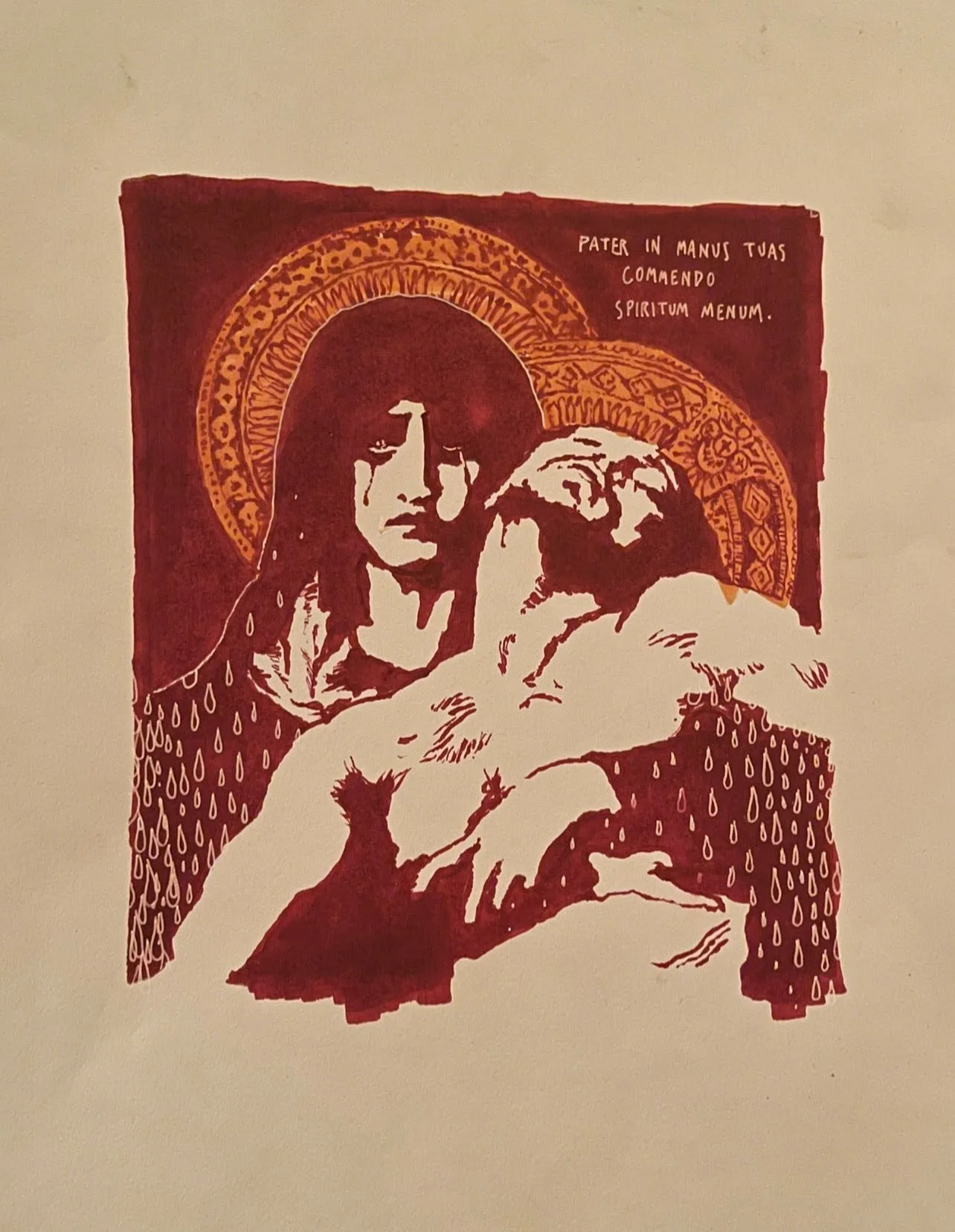
Art by my daughter, Sophie Into your hands, Lord, I commend my spirit
Science of the Cross
Edith Stein asks the harder question: Will you allow the mystery of the Cross to become your inner form? That is the Science of the Cross. The goal of healing is not to become so comfortable and docile or removed form the real life that nothing can ever pierce us again. It is to become so alive and honest in body, soul, and spirit that we can refuse counterfeit crosses, resist evil, do not give in into counterfeit spiritualities, receive healing where healing is needed, and still possess enough freedom, strength, and love to carry the real cross. That is vitality under the Cross. Not merely feeling better, but becoming fruitful.
And this is also the question behind HARMONY: it is not about creating a life with no suffering, no stress, and no limits. It is about restoring enough order in body, soul, and spirit that you can hear clearly, discern wisely, respond freely, and live the vocation God has actually given you.
So here is the prompt I would leave you with: What in your life right now truly needs healing, what needs to be resisted, what needs to be surrendered, and what might actually be your cross to carry? If you cannot yet tell the difference, that may be exactly where the work begins. HARMONY is designed to help you restore vitality, recover discernment, and become strong enough to live faithfully, not merely comfortably.
I will leave more Edith Stein’s quotes for today’s feast:
“One cannot desire freedom from the Cross when one is especially chosen for the Cross.”
“To suffer and to be happy although suffering, to have one’s feet on the earth, to walk on the dirty and rough paths of this earth and yet to be enthroned with Christ at the Father’s right hand, to laugh and cry with the children of this world and ceaselessly sing the praises of God with the choirs of angels—this is the life of the Christian until the morning of eternity breaks forth.”
“You can be at all fronts, wherever there is grief, in the power of the cross. Your compassionate love takes you everywhere, this love from the divine heart. Its precious blood is poured everywhere, soothing, healing, saving.”