Women Who Stay
Mary Magdalene stayed near the tomb. She had no explanation for what had happened. She did not understand the Resurrection yet. She simply knew that Jesus was missing, and love would not let her walk away. That’s faith standing beside a place of death because she refuses to leave love behind.
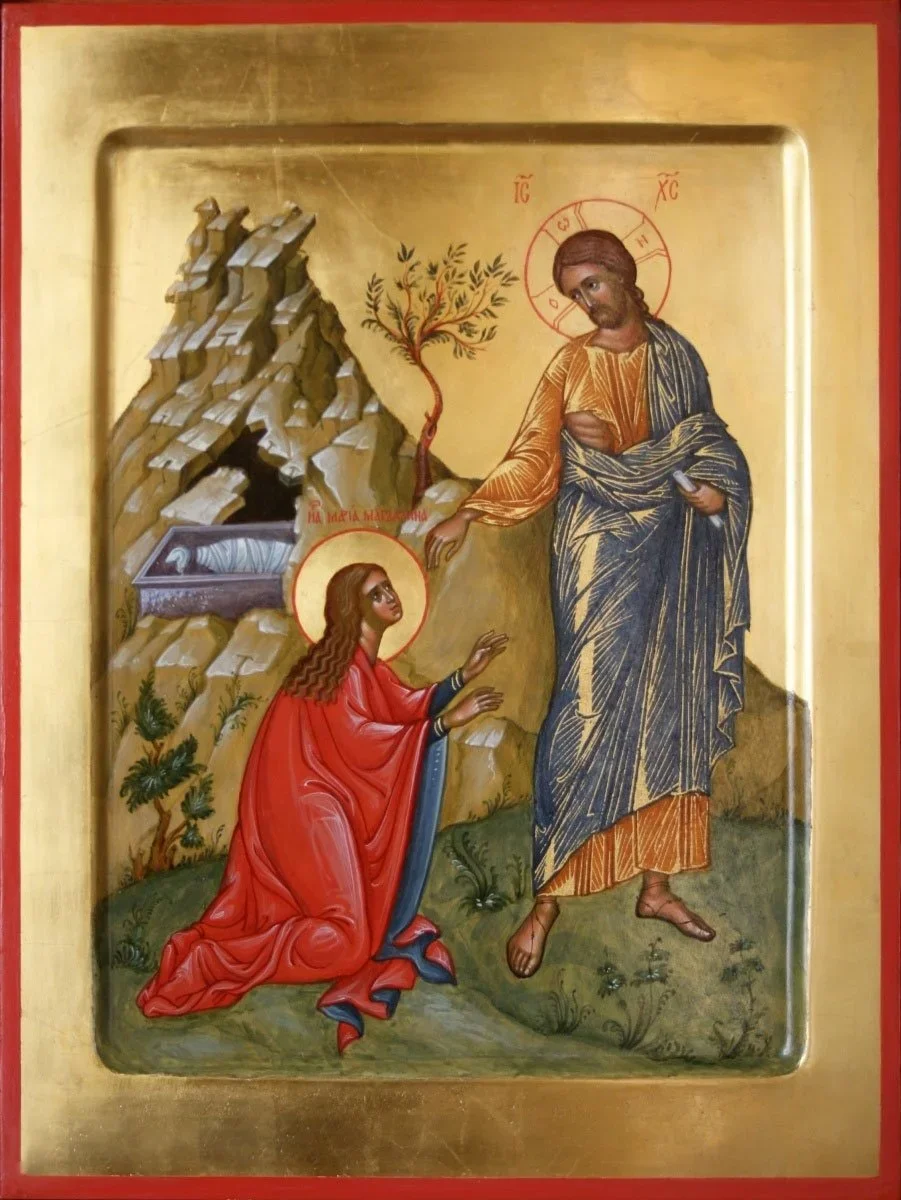
Christ and Saint Mary Magdalene in the Garden
Mary Magdalene has been covered with layers of speculation that the Gospel itself does not place upon her. Scripture does not call her a prostitute. It tells us that Jesus delivered her from seven demons, that she followed Him, and that she helped support His ministry. That Jesus allowed women to follow Him and be legit disciples as men were, that was already huge and unusual. She was not standing at the edge of the story as a decorative female disciple. Her life, her resources, her loyalty, and her reputation were invested in her Teacher’s Life.
Mary knew what it meant to be restored. She had experienced the difference between captivity and freedom. When Christ gave her life back, He did not ask her to spend the rest of it apologizing for having once been broken. He gave her a mission.
On Easter morning, Mary came looking for a body and encountered the risen Lord in a garden. Eden had to be restored. At first, she thought He was the gardener. She was mistaken, but not completely. Christ is the Gardener of the new creation and in Him, creation begins to grow again.
Mary was crying because she believed the story had ended. Jesus was standing in front of her because the story had only just begun. Then He called her by name.
She did not recognize Him through an argument, an explanation, or a carefully prepared theological presentation. She recognized Him when He said, “Mary.” Resurrection became personal before it became proclamation. Christ did not address women as a demographic group. He spoke to one woman whose life history, grief, wounds, love, and name He knew completely.
Then He sent her to speak.
This is where the story becomes inconvenient for anyone who prefers holy women to remain quiet, agreeable, and tastefully arranged near the flowers. Jesus entrusted the first announcement of the Resurrection to Mary Magdalene. The apostles had to receive the news from a woman before they could proclaim it to the world. Mary did not appoint herself. She did not create a platform, announce a new ministry, or commission a photographer to capture her “Apostle to the Apostles” season. Her authority came from encounter and obedience. She had seen the Lord, heard Him speak her name, and received a command to go.
More than a thousand years later, another woman found herself speaking to a Church that was alive but desperately in need of renewal. Hildegard of Bingen was a Benedictine abbess, composer, visionary, teacher, and fierce critic of corruption. She described herself as weak and unlearned, then proceeded to write to popes, bishops, emperors, abbots, priests, and anyone else who needed correction. Apparently, nobody had explained to Hildegard that female humility was supposed to mean having no opinions.
She did not speak because she thought herself impressive. She spoke because she was told to write what she has seen. Prophetic authority is not self-importance wearing religious clothing. It is obedience that would often prefer a quieter life, less criticism, less doubts.
Mary Magdalene and Hildegard were very different women living in very different worlds, but they shared something the Church still needs. Mary carried a history of profound spiritual suffering. Hildegard lived with physical frailty and recurring illness. Neither waited to become invulnerable before obeying God.
Modern spirituality often treats healing as a performance. We feel the need to do meetings to pray for healing, conferences to enhance the ministry teams’ authority and designation. We also feel pressure to appear fully restored, always emotionally regulated, physically radiant in social situations at all times, and ready to teach a course about it. Yet God has never limited Himself to women who can present a polished recovery story.
He speaks through women who have wept, suffered, and whose bodies remind them that they are creatures, not machines.
Mary’s tears are especially important. We often treat tears as a failure of faith or an interruption to productivity. Jesus did not rebuke Mary for crying. He asked her why she was weeping not because He lacked information, but because grief must be brought into relationship before it can be transformed.
Her tears revealed the depth of her love. She remained near the tomb when others had already gone home. Had she hurried away in the name of “moving forward,” or “letting go” she might have missed the risen Christ.
Not every sorrow should be prolonged, and not every tear reveals wisdom. Yet grief brought honestly before Christ can become a doorway. Mary looked into the place of death, told the truth about what she believed had been lost, heard her name, and turned toward Jesus. That movement is the heart of healing. We face what has died. We stop pretending that nothing hurts. We listen for the voice of Christ. And only then we turn.
Hildegard had a word that helps us understand what happened in that garden. She wrote about viriditas, the greening vitality of God that brings freshness, growth, fertility, and life. It is the power by which the dry becomes living and the barren becomes fruitful. Mary Magdalene came searching for a corpse and encountered Life Himself.
This is what Christ does. He does not merely teach us how to cope more efficiently with dead things. He does not tell us to “let go” and try to burry, forget, dismiss, supress, dismiss or pretend ‘by faith’ that it does not matter any more. His resurrection is about living while keeping the tomb open. The memory does not cancel the reality, it stregthens it. The rolling stone does not dissappear, the burial cloths do not get trashed, they are cherished. The material witnesses, the memories are becoming part of the greatest story ever told.
He raises the dead. He opens them. He does not ask exhausted people to become better managers of depletion. He restores life at its source. Sometimes His voice brings consolation. Sometimes it brings wisdom and sometimes it brings a song. Sometimes it brings a warning that nobody requested and almost everyone needed.
We need women who stay near the tomb. Not because women should remain trapped in grief, but because someone must remain close enough to recognize resurrection. We are in need of distinguishing darkness from defeat, burial from annihilation, and silence from absence.
And the Church needs women who understand bodies, waiting, birth, blood, loss, endurance, and renewal. It needs women who are not frightened by tears and do not confuse loudness and popularity with authority. It needs women who will stay, listen, turn, and speak when Christ tells them to go. Mary Magdalene proclaimed that she had seen the Lord. Hildegard proclaimed that divine life was still capable of greening what had become dry.
Both remind us that when Christ restores a woman, He does not merely make her more pleasant, more manageable, or better able to endure depletion. He makes her a witness.
See if TASTE and SEE is the next step for you to become a witness.